

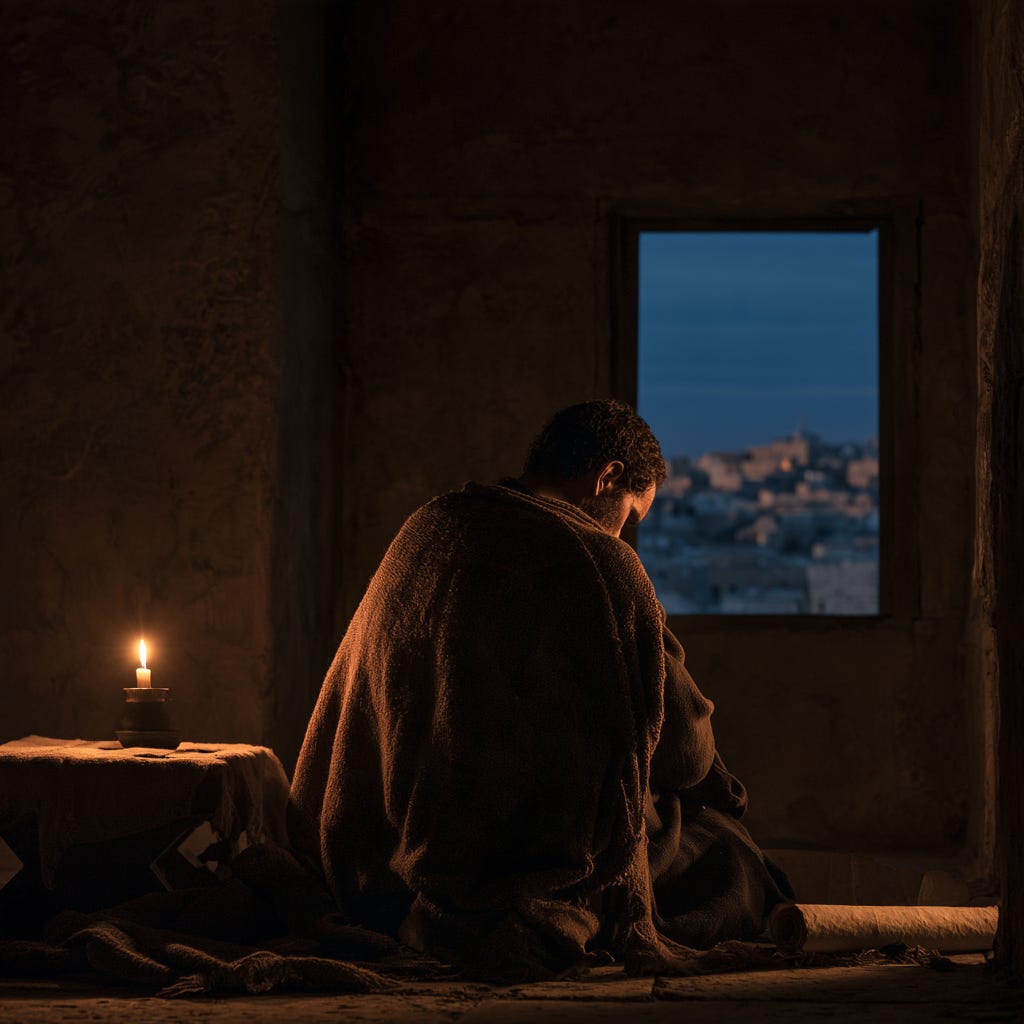
Sermon 33 of the series: Romans: Gospel Blueprint
Review
Paul answered a question for every believer who suffers: when trouble keeps coming, does Christ still love me? He began with a question of his own: who shall separate us from the love of Christ (8:35)? He named seven hardships and quoted a psalm of lament, because the suffering of God’s people is nothing new (8:36). Then he answered with one word: no. In all these things we are more than conquerors through Him who loved us (8:37). He closed with a personal testimony. Neither death nor life, nor things present nor things to come, nor anything else in all creation, will be able to separate us from the love of God in Christ Jesus our Lord (8:38-39).
That is the highest note of assurance in the letter. But it raises a hard question. God made promises to Israel long before He made them to us, and most of Israel has not believed in her own Messiah. If nothing can separate God’s people from His love, what about Israel? Paul turns to that question now. He does not begin with an argument. He begins with tears, then counts what God gave to Israel, and ends in worship of the Christ who is God over all.
Great Sorrow
Paul moves from the peak of chapter 8 to the valley of chapter 9 without a connecting word. The man who has just said “I am sure” now says “I have great sorrow.” Before he tells us what grieves him, he takes an oath that his grief is real.
Romans 9:1-3: I am speaking the truth in Christ—I am not lying; my conscience bears me witness in the Holy Spirit— 2that I have great sorrow and unceasing anguish in my heart. 3For I could wish that I myself were accursed and cut off from Christ for the sake of my brothers, my kinsmen according to the flesh.
Paul says it three ways: he speaks the truth in Christ, he is not lying, and his conscience bears him witness in the Holy Spirit. Why so emphatic? He was the apostle to the Gentiles, and many of his own people thought he had turned against them (Acts 21:21, 28). Paul wants the church in Rome to know that the opposite is true.[1]
His sorrow is “great” and his anguish is “unceasing.” He does not yet say why, but the reason is plain from what follows. His kinsmen have rejected the Messiah, and apart from Him they are not saved (10:1). So Paul says something astonishing. He could wish to be “accursed,” devoted to destruction, and cut off from Christ, if that would save them.
Notice the words “I could wish.” Paul knows the wish cannot be granted. He has just said that nothing in all creation can separate us from the love of God in Christ (8:39). But the wish shows his heart. It echoes Moses, who asked to be blotted out of God’s book for the sake of Israel after the golden calf (Ex 32:30-32).[2] God did not accept the offer of Moses, and He would not accept the offer of Paul. Only One could become a curse for others, and He did (Gal 3:13).
This is how the chapter on God’s sovereign choice begins. The apostle who teaches election does so with a broken heart.
Great Privileges
Paul now explains why the unbelief of his kinsmen is so painful. These are not strangers to God. He lists what God has given them, and each gift makes the tragedy heavier.
Romans 9:4-5a: They are Israelites, and to them belong the adoption, the glory, the covenants, the giving of the law, the worship, and the promises. 5To them belong the patriarchs...
He begins with the name. They are “Israelites,” the covenant name God gave to Jacob (Gen 32:28). Paul speaks in the present tense: they are Israelites, and these gifts belong to them. Their unbelief has not erased what God gave.
Then he counts the gifts:
§ The adoption. God called Israel His firstborn son (Ex 4:22; Hos 11:1). It is the same word Paul used for believers in 8:15 and 8:23.[3]
§ The glory. God’s presence filled the tabernacle and the temple (Ex 40:34; 1 Ki 8:11).
§ The covenants. God bound Himself to Abraham, to the nation at Sinai, and to David (Gen 15; Ex 24; 2 Sam 7).
§ The giving of the law. At Sinai, God made His will known to them as to no other nation (Dt 4:8).
§ The worship. They had the priesthood and the sacrifices, the appointed way to draw near to God.
§ The promises. Above all, the promises of the Messiah and His kingdom.
§ The patriarchs. Abraham, Isaac, and Jacob are their fathers.
Notice what this list does to the question from chapter 8. The blessings Paul has just celebrated for the church, such as adoption, glory, and promise, were Israel’s first. That is why Israel’s unbelief is more than a sad fact. It seems to put God’s faithfulness on trial.
It also teaches us that privilege is not the same as salvation. Israel had every advantage, and yet most did not believe. One can be surrounded by the things of God and still miss the Son of God.
Christ Over All
Paul closes with a personal testimony: “I am sure.” This is not a mood but his settled, authoritative judgment.[4] He lists every threat he can think of, mostly in pairs, so that nothing is left outside the promise.
Romans 9:5b: ...and from their race, according to the flesh, is the Christ, who is God over all, blessed forever. Amen.
Notice the change in wording. The patriarchs “belong” to Israel, but the Christ is “from” them. He came out of Israel, yet He is not Israel’s possession alone. He is the Savior of Jew and Gentile alike (1:16).
“According to the flesh” speaks of His human descent, as in 1:3, where Paul said He was descended from David according to the flesh. The phrase tells us there is more to say about Him. He is truly a son of Israel, but He is more than a son of Israel.
Paul then says who He is: “God over all, blessed forever.” Some punctuate the verse so that the last words become a separate praise to God the Father. But the words “who is” point most naturally to the Christ just named. “According to the flesh” leads us to expect a statement about His other side. And when Paul gives an independent blessing to God, he normally puts the word “blessed” first (2 Cor 1:3; Eph 1:3). The reading of the ESV is the better one.[5]
So this is one of the clearest statements of the deity of Christ in the New Testament. The Messiah whom Israel rejected is God over all. That makes the sorrow deeper, because of whom they have refused. It also makes the hope stronger. If Christ is God over all, then Israel’s unbelief is not beyond His rule, and the story is not over.
Paul ends with “Amen.” His anguish has not been removed, yet he worships. That raises the question he must now answer. If Israel had all this and still did not believe, has the word of God failed? Paul takes that up next (9:6).
Application
1. Let us ask God for Paul’s heart toward the lost. Sound doctrine and deep sorrow belong together. Let us name our own kinsmen who are without Christ, our family, friends, and countrymen, and pray for them without ceasing. When we speak the truth to them, let us speak it with love and not with coldness.
2. Let us not confuse privilege with salvation. A Christian home, church membership, baptism, and years of hearing the Bible are gifts from God, but they are meant to lead us to Christ. Let us examine ourselves and come to Him in faith. And let us honor the Jewish roots of our faith, leaving no room for pride or contempt.
Let us worship Christ as God over all, even in sorrow. Paul’s grief ended in “Amen.” When we carry burdens for people we love, let us bring them to the One who rules over all things, and let us trust Him with the stories that are not yet finished.
[1] Douglas J. Moo, The Letter to the Romans, 2nd ed. (Eerdmans, 2018), on 9:1-2, on the force of Paul’s threefold assertion.
[2] Moo, The Letter to the Romans, 9:3, on the unattainable wish and the echo of Moses.
[3] Thomas R. Schreiner, Romans (Baker Exegetical Commentary on the New Testament), 2nd ed. (Baker Academic, 2018), 9:4, on “adoption” as the word used of believers in 8:15 and 8:23.
[4] Schreiner, Romans (Baker Exegetical Commentary on the New Testament), 456.
[5] Moo, The Letter to the Romans, on 9:5; Shreiner, on 9:5; F.F. Bruce, (Romans (IVP, 2015), on 9:5, each talking “God over all” as a description of Christ.
“Scripture quotations are from The ESV® Bible (The Holy Bible, English Standard Version®), © 2001 by Crossway, a publishing ministry of Good News Publishers. Used by permission. All rights reserved.”
PAUL’S ANGUISH FOR ISRAEL
by Ed Pilapil Jr

Paul spoke the truth; He did not lie
He shared with us his deepest cry
Great sorrow would not let him rest
For kinsmen who have not confessed

He’s bear the curse, if that could be
Cut off from Christ to set them free
Like Moses pleading for his own
Yet Christ could bear the curse alone

Adoption, glory, and the law
The covenants, the worship’s awe
The promises, the fathers’ line
These gifts were theirs by God’s design

From them, in fresh, the Christ was born
The One whom many met with scorn
Yet He is God, forever blessed
In Him alone our soul find rest
Study Guide
1. Why does Paul affirm his truthfulness three times before speaking of his sorrow? What does his wish to be “accursed and cut off from Christ” reveal about his heart, and how does it compare with Moses’ prayer? (Ro 9:1-3; cf. Ex 32:30-32; Gal 3:13)
2. List the privileges Paul names. Which of them has he already applied to believers in chapter 8? What does Israel’s unbelief teach us about the difference between privilege and salvation? (Ro 9:4-5a; cf. 8:15, 18, 23)
3. What does “according to the flesh” tell us about the Christ, and what does “God over all” add?
4. What can we learn from the text about the state of our hearts when we pray and proclaim to the lost?
