


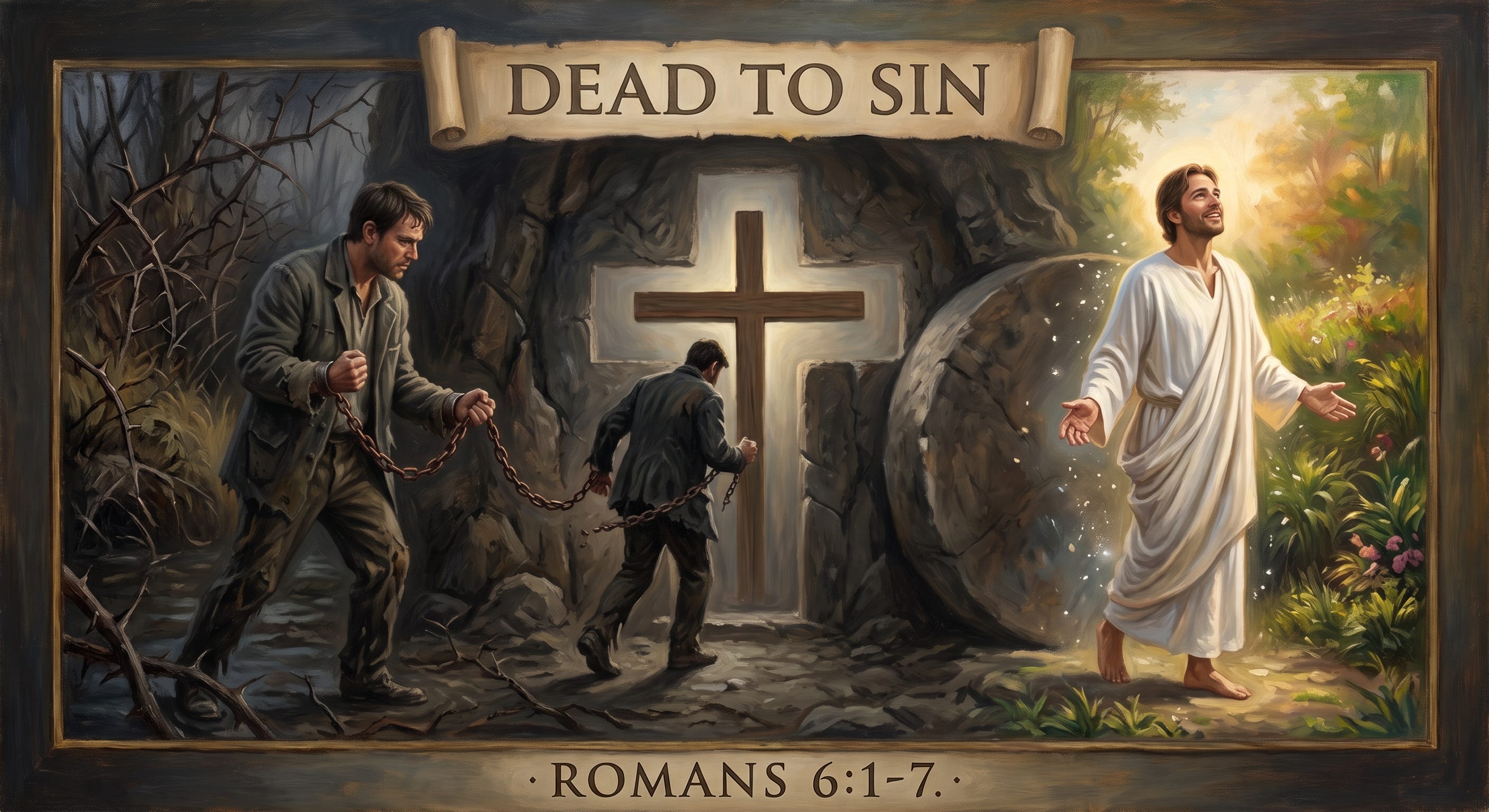
Twentieth in the Sermon Series. “Romans: Gospel Blueprint.”
Paul has been explaining the gospel in different ways. Justified by faith, we have peace with God (5:1). While we were still sinners and enemies, Christ died for us (5:8). Then Paul drew a great contrast: Adam’s one act of disobedience brought sin, death, and condemnation to the whole human race. However, Christ’s obedience brought grace, righteousness, and life (5:12-21). Paul pushed the contrast to the extreme by stating that where sin increased, grace increased all the more (5:20). But the apostle must warn the reader not to misinterpret abounding grace. Abounding grace is not a license to sin more.
Grace is Not a License to Sin
Paul begins by staging a debate. He raises a question regarding his previous statement that grace abounds even if sin increases. The objection is almost clever: if my sin gives God more occasions to show His grace, isn’t sinning in favor of God? The answer is NO. Then he gives the reason.
Romans 6:1-2: What shall we say then? Are we to continue in sin that grace may abound? 2 By no means! How can we who died to sin still live in it?
The apostle’s reply to the question is “by no means!” He uses another question to answer the previous question. Those who truly have faith have died to sin. Notice the little word “to.” Paul says we died with respect to sin, not that sin has vanished from the world, and not that we can no longer feel its pull.[1] It means our fundamental relationship to it has been severed.
Baptized Into His Death
How did we die to sin? Paul answers with being baptized into Christ’s death. The word baptized means to plunge or immerse; the word used for an object completely dropped under water. Although the ordinance of water baptism stands in the background, the main point is that genuine faith plunges the believer into Christ’s death.[2]
Romans 6:3-4: Do you not know that all of us who have been baptized into Christ Jesus were baptized into his death? 4 We were buried therefore with him by baptism into death, in order that, just as Christ was raised from the dead by the glory of the Father, we too might walk in newness of life.
Paul would then push the imagery even more by stating that the believer is buried with Him. Burial is done to those who are truly dead. But the apostle does not stop at burial; he pushes the parallel even more. Paul relates the resurrection of Christ to the new life of the believer.
Old Self Crucified
Paul gives an image of unity, of being joined together in His death and resurrection. He shows a concept of the old self being crucified with Christ. The purpose? So that the believer would no longer be a slave to sin, meaning that sin is no longer the master.[3]
Romans 6:5-7: For if we have been united with him in a death like his, we shall certainly be united with him in a resurrection like his. 6 We know that our old self was crucified with him in order that the body of sin might be brought to nothing, so that we would no longer be enslaved to sin. 7 For one who has died has been set free from sin.
Note that the old self might refer to Adam. The reader must note that Paul is not promising sinless perfection. He is explaining that sin has no more legal right or claim. Although temptation will always lurk, sin is no longer the owner or master of the body.
Application
1. God’s abounding grace is not a license to sin. Do not treat grace as a legal loophole. We can no longer live as those who pursue sin because we have died to sin. Genuine faith does not pursue sin; it dies to it.
2. We are not Christians trying to merely improve; we are sinners who were justified by faith. Such faith means that you died to sin, were buried, and were given a new life. Christ’s death is our death; His resurrection is our new life.
3. We must stop treating sin as our rightful master. As genuine believers, we can resist its desire to treat us as slaves. However, through faith, we reckon ourselves dead to it and no longer enslaved. The old self is replaced by the new life in Christ because of His resurrection.
[1] Frank S. Thielman, Romans, ed. Clinton E. Arnold, Exegetical Commentary on the New Testament (Zondervan Academic, 2018), 6:2. Thielman notes that they have not died in every sense, but they have died with respect to sin citing Daniel B. Wallace, Greek Grammar Beyond the Basics (Grand Rapids: Zondervan, 1996), 154.
[2] Thomas R. Schreiner, Romans (Baker Exegetical Commentary on the New Testament), 2nd ed. (Baker Academic, 2018), 6:3-4. Schreiner explains that those baptized into Christ “were baptized ‘into his death’.... This means that they were plunged into his death, immersed together with him in it.” He affirms that the reference is to water baptism, while insisting that “baptism itself is not the central theme of the text; the main theme is the believer’s participation with the death and resurrection of Christ.”
[3] Richard N. Longenecker, The Epistle to the Romans (Grand Rapids, MI: Eerdmans, 2016), 6:5-7. Longenecker writes that believers “have been united with him” and “crucified with him” in Jesus’ death, and yet “at the present time believers in Jesus live their lives in the hope, which has been given by God, ‘that the body of sin will be done away with’ and ‘that we should no longer be slaves to sin.’”
DEAD TO SIN
by Ed Pilapil Jr

Stop the foolish thinking today
In old sinful self, do not stay
Faith also means dying to sin
We cannot make our home therein

How can we remain when we died
That’s from sin and all of sin’s pride
Buried too, there’s no doubt of death
Then, we have resurrection’s wealth

The old self, in the cross was slain
Thus, sinful self no longer reigns
Broke sin’s power, He set us free
Yes, we’re free from sin’s tyranny

We’re dead to sin, in Christ, we’re whole
New life, now lived, in heart and soul
The grace that abounds made it so
Therefore, to sin, we must say NO
Study Guide
1. In your own words, why does Paul consider “keep sinning so grace can increase” not just wrong but absurd? What does the phrase “died to sin” actually mean, and what does it not mean? (Ro 6:1-2)
2. Paul uses two vivid pictures: (1) being “plunged/immersed into Christ” and (2) being “buried with him.” What does each picture teach us about our union with Christ? Where does the power for our new life come from? (Ro 6:3-4)
3. How would you explain “brought to nothing” in your own words, and why is freedom from sin’s slavery different from sinless perfection? (Ro 6:5-7)
