


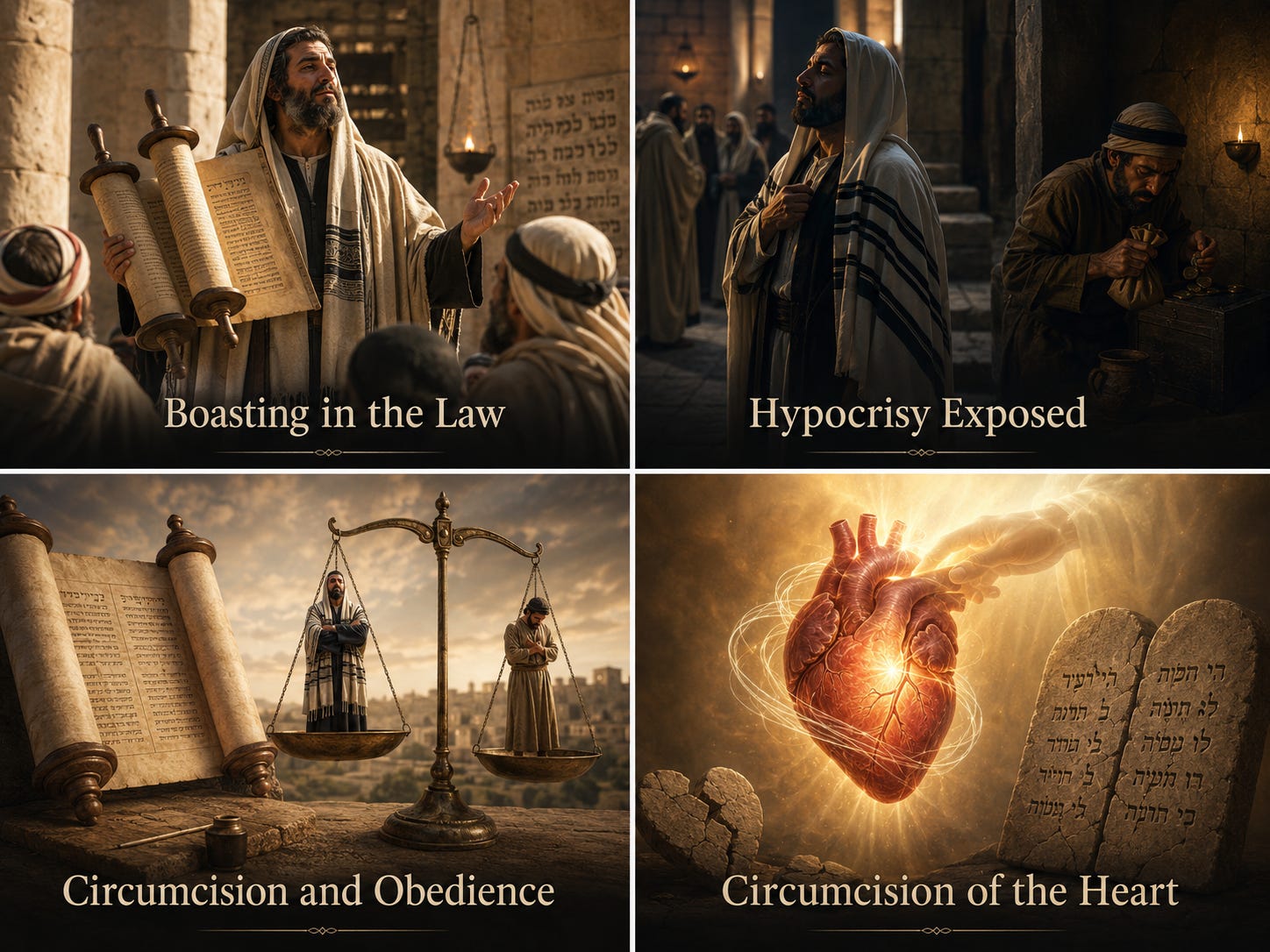
Eleventh in the sermon series, “Romans: Gospel Blueprint.”
Paul argued that God is impartial to both Jews and Gentiles. The Gentiles who do not have the Mosaic Law will be judged without it. Their conscience will be the basis. The Jew will be judged by the Mosaic Law, whether they obeyed it or not. Paul continues to expose the hypocrisy of the Jews who rely on knowing the law instead of obeying the law. Paul is building up to a truth that would be difficult for the Jew: that no one, absolutely no Jew, fulfilled the law, except Christ. He returns to his interlocutor, whom he identifies as a Jew. By using an interlocutor, Paul is not necessarily stating that all Jews think the same. However, those who do are the ones that he is addressing.[1]
False Confidence
Paul challenges the Jews who rely on the law and boast in God.[2] The verb “relies on” (Greek ἐπαναπαύῃ, epanapauē) pictures leaning on something for support. Israel had leaders who leaned on the Lord yet acted unjustly (Micah 3:11). Paul also refers to Israel’s role in the world as a light, but he does not complete the quotation from Isaiah 42:6-7.
Romans 2:17-20, ESV: But if you call yourself a Jew and rely on the law and boast in God 18 and know his will and approve what is excellent, because you are instructed from the law; 19 and if you are sure that you yourself are a guide to the blind, a light to those who are in darkness, 20 an instructor of the foolish, a teacher of children, having in the law the embodiment of knowledge and truth—
When Paul highlighted the sins of the Gentiles, it was about rejecting the knowledge of God. To explain to the Jew that they are also guilty, he highlights their knowledge of God, yet they still disobey His commands. They have a semblance of righteousness but act unrighteously.
Hypocrisy
After stating the role of Jews in God’s plan, which was to be a light to the darkness, a nation to show other nations the way, he now uses probing questions. The apostle ends with a powerful statement to the self-righteous Jew. He references the exile where the name of God was blasphemed (Isa 52:5).
Romans 2:21-24: you then who teach others, do you not teach yourself? While you preach against stealing, do you steal? 22 You who say that one must not commit adultery, do you commit adultery? You who abhor idols, do you rob temples? 23 You who boast in the law dishonor God by breaking the law. 24 For, as it is written, “The name of God is blasphemed among the Gentiles because of you.”
Paul referenced what happened on a national scale to apply it to the inner person. The apostle wants the interlocutor, who represents strong Jewish beliefs, to reflect on whether they have lived in hypocrisy.
Inner Person
Paul shifts to circumcision, a defining badge of covenant identity. Yet he argues that circumcision without obedience “becomes uncircumcision,” while an obedient gentile’s uncircumcision is “counted as circumcision.” What does this imply? It implies belonging to the covenant identity.[3] The apostle also emphasizes obedience, the heart, and the Spirit.
Romans 2:25-29: For circumcision indeed is of value if you obey the law, but if you break the law, your circumcision becomes uncircumcision. 26 So, if a man who is uncircumcised keeps the precepts of the law, will not his uncircumcision be regarded as circumcision? 27 Then he who is physically uncircumcised but keeps the law will condemn you who have the written code and circumcision but break the law. 28 For no one is a Jew who is merely one outwardly, nor is circumcision outward and physical. 29 But a Jew is one inwardly, and circumcision is a matter of the heart, by the Spirit, not by the letter. His praise is not from man but from God.
Paul exposes the danger of leaning on the law for security while failing to obey it. Such a posture is false confidence that mistakes religious privilege for righteousness. God would sooner approve an obedient outsider, who has the law on his heart, than a Jew who possesses and teaches the law yet does not live it. Paul’s focus was not to prove that there were righteous Gentiles, but that the Jew must abandon his self-righteousness (his confidence in heritage and ritual).
Application
1. It is possible to know what God expects yet remain disqualified in His eyes. Let us know His word, especially the gospel, and then let us believe in the gospel, repent of our sins, and live a life of faith in obedience.
2. Our hypocrisy is never a private matter. When our lives contradict our message, we don’t merely harm ourselves; we drag God’s reputation through the mud before a watching world. Let us continuously and humbly reflect on our own lives in the light of His Word.
3. The question is not whether we bear the right external signs, like going to church or reading the Bible, but whether the Spirit has done His transforming work within us. And the verdict that finally matters comes not from people, but from God. Never neglect the inner life, the meditations and intents of the heart.
[1] Frank S. Thielman, Romans, ed. Clinton E. Arnold, Exegetical Commentary on the New Testament (Zondervan Academic, 2018), 2:21-23.
[2] Boasting in God is not wrong. Paul is addressing a misguided confidence. See Douglas J. Moo, The Letter to the Romans, 2nd ed. (Eerdmans, 2018), 170.
[3] Thomas R. Schreiner, Romans (Baker Exegetical Commentary on the New Testament), 2nd ed. (Baker Academic, 2018), 136.
Poem
MISGUIDED FAITH
by Ed Pilapil Jr

They believed in the law, but then
Who obeys the law, among men?
O self-righteous Jew, just let go
Your inner state, reveal it so

The posture of high and holy
Replace with the gospel, fully
False confidence is misguidance
It is a form of defiance

Now let go of all defiance
Know the word, reject misguidance
We’re sinners, we confess fully
Saved by the One who is holy

Now my goodness, I know it so
Of self-righteousness, I let go
Christ, our profession among men
We’ll proclaim Him as they did then
Study Guide
1. Who was Paul addressing? Explain the role of the Jewish people as stated in the OT. (Ro 2:17-20)
2. What was the purpose of Paul’s questions? How would you write questions to yourself? (Ro 2:21-24)
3. Explain the statement from its context that circumcision is a matter of the heart. (Ro 2:25-29)
