


Review
Paul answered a question for every believer who still suffers: how can we be sure God will finish what He has begun? He answered with five verbs, the links of the golden chain. Those whom God foreknew, He also predestined to be conformed to the image of His Son, in order that Christ might be the firstborn among many brothers (8:29). The chain began before time, when God set His love on His people. Those whom He predestined, He also called, and those whom He called, He also justified (8:30a). What God planned in eternity, He carried out in history. His call overcame our resistance, and His verdict is why there is no condemnation for those in Christ Jesus (8:1). And those whom He justified, He also glorified (8:30b). Paul wrote it in the past tense, though our glory is still to be revealed (8:18), because in God’s plan it is as good as done.
Every link is God’s action, and no one falls out between the links. But believers still live in a world of accusation, hardship, and death. That leaves a final question for every believer who feels the pressure: when everything seems to come against us, can anything undo what God has done? Paul answers with a series of questions of his own. He begins by taking us into the courtroom, where we learn that God is on our side, no charge will stand, and Christ Himself is interceding for us.
God is for Us
Paul gathers everything he has said into one question: “What then shall we say to these things?” The phrase reaches back to the suffering and the golden chain of 8:18-30, and it caps the whole discussion of assurance that began in chapter 5.[1] His answer is another question. If God is for us, who can be against us? Then he gives the proof: the cross.
Romans 8:31-32: What then shall we say to these things? If God is for us, who can be against us? 32He who did not spare his own Son but gave him up for us all, how will he not also with him graciously give us all things?
Paul does not say that believers have no enemies. Sin, death, the flesh, and a hostile world are real, and Paul has named them all. His point is that God has taken our side, and the side God takes will prevail.[2]
How do we know? God did not spare His own Son. “Own” sets Jesus apart from the many adopted sons of 8:14-16. The language echoes Genesis 22, where Abraham did not withhold Isaac. But Isaac was spared at the last moment, and a substitute was provided. God’s Son was not spared; He is the substitute. “Gave him up” also recalls the Servant of Isaiah 53, and it tells us that the cross was the Father’s own initiative.[3]
Then Paul reasons from the greater to the lesser. If God has already given the most costly gift, how will He not give the rest? “All things” centers on what is needed for our final salvation, but it includes every blessing, spiritual and material, that we require on the way there. As Chrysostom asked, “Why be dubious about the chattels, when you have the Lord?”[4] This is not a promise of wealth or ease. Only three verses later, Paul lists famine and nakedness among the things believers face. God gives all that we need to reach glory, and He defines what that is.
God Justifies
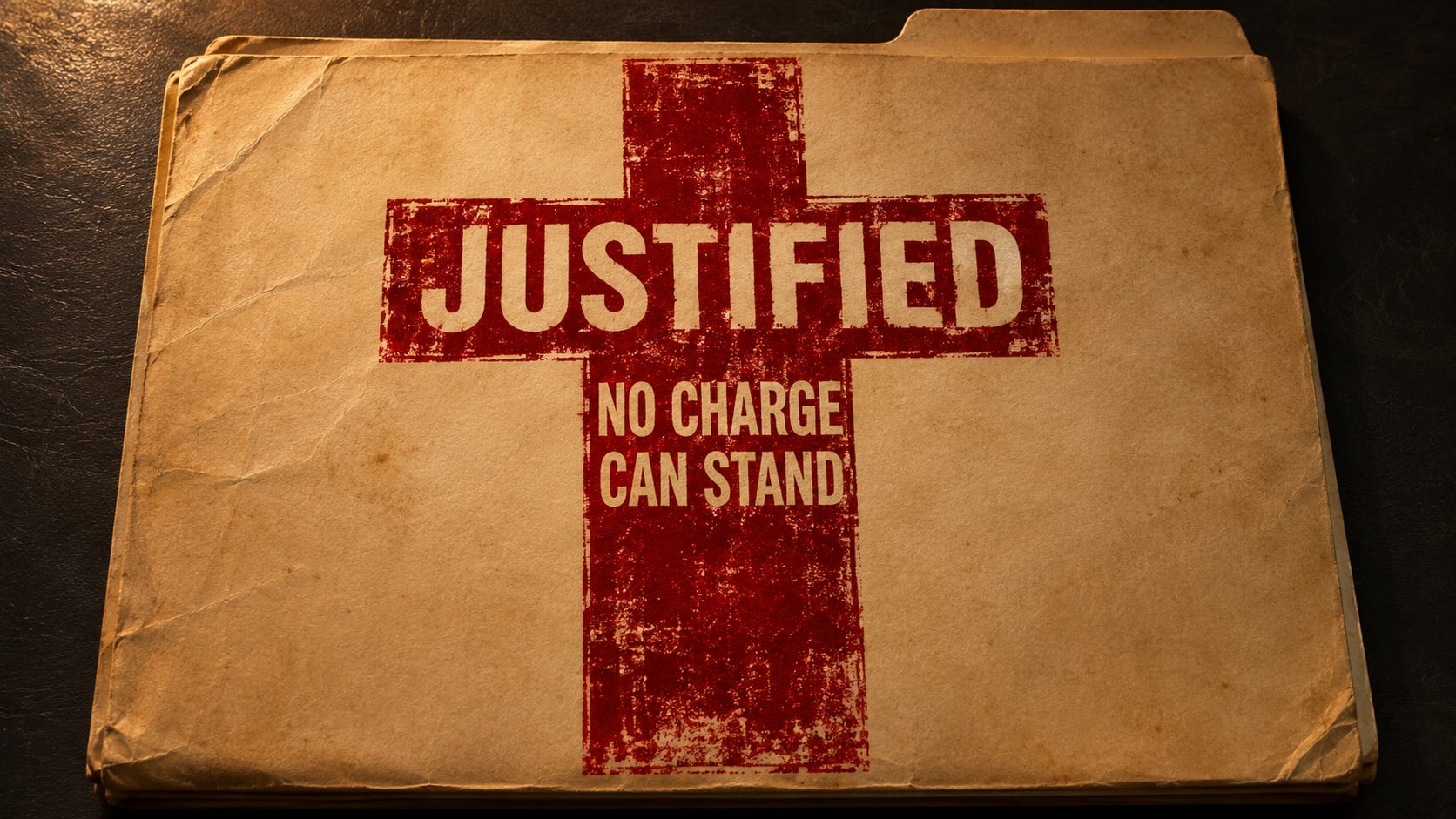
Paul moves into the courtroom. He pictures someone standing up to accuse the people of God. He does not answer with the believer’s record. He answers with the verdict of the Judge.
Romans 8:33: Who shall bring any charge against God’s elect? It is God who justifies.
Paul is not saying that no one will accuse us. Accusations come from our conscience, from the enemy, and from the people around us. He is saying that no accusation will stick. Believers can face the day of judgment with confidence, because God has already declared them right in His sight.[5] The verdict also matters now. Believers in Rome were being mistreated by the wider society, and God was already declaring those accusations unwarranted.
Notice the link to the golden chain. In Greek, “called” in 8:30 and “bring any charge” in 8:33 are closely related words. Those God has called, no one can successfully charge. Notice also the word “elect.” The charge is not being brought against people who chose themselves. It is brought against those God chose, and to accuse them is to challenge the One who chose them.[6]
Paul is echoing the Servant of the Lord in Isaiah 50:8-9. The Servant could face his adversaries because the Lord would vindicate him. Paul takes those words and places them in the mouth of every believer.[7] We stand where the Servant stood because we are joined to Him.
Christ Intercedes
Paul asks the natural follow-up. If God justifies, who is to condemn? He answers with four statements about Christ Jesus, and each one rises above the last.[8] The whole weight falls on the final statement: He is interceding for us.
Romans 8:34: Who is to condemn? Christ Jesus is the one who died—more than that, who was raised—who is at the right hand of God, who indeed is interceding for us.
He died, so God’s wrath against us has been satisfied (3:21-26). More than that, He was raised. The resurrection was God’s vindication of Jesus, and since we are united to Him by faith, His vindication is ours (4:25).[9]
He is at the right hand of God, the place of authority promised in Psalm 110:1. But Paul does not stop at Christ’s honor. The high point is what Christ does with that position. He is interceding for us. The word was used in legal settings and for appeals made before a king on someone’s behalf.[10] Here is the risen King, pleading for His people on the basis of His own atoning death. It also recalls the Servant who “makes intercession for the transgressors” (Isa 53:12), and it is why John can call Him our advocate with the Father (1 Jn 2:1).[11]
Christ does not plead with an unwilling Father. It was the Father who gave Him up (8:32). He stands before the Father as the living guarantee that the verdict holds. So believers have two intercessors: the Spirit within us (8:26-27) and the Son above us (8:34). This is why there is “no condemnation” (8:1). That settles the courtroom. But a suffering believer may still ask a more personal question, and Paul takes it up next: does Christ still love me in all of this?
Application
1. When hardship tempts us to think God is against us, we do not begin with our circumstances. We begin with what He has already given: His own Son. Let us bring our needs to Him with confidence and let Him define what we need on the way to glory.
2. When our conscience, the enemy, or other people bring up our sins, we do not hide or defend ourselves. We confess what is true and rest in the fact that God has justified us. And let us not become accusers of those whom God has declared righteous.
3. Let us go to the Father through the Son who intercedes for us. When we feel condemned, we look to the One who died, was raised, reigns, and prays for us. We do not stay away from God until we feel worthy. We draw near because our Advocate is already there.
GOD FOR US
If God is for us, who can be
Against the ones He has set free?
He did not spare His own, dear Son
Will He not finish what’s begun

The Father gave; it was His will
He sent His Son to pay our bill
How will He then withhold the rest
From those He’s called, from those He’s blessed?

Who brings a charge? The case is through
The Judge has ruled, His verdict true
The accuser’s voice may still be heard
But God has given the final word

Christ died and rose, at God’s right hand
He pleads for us, and so we stand
Who can condemn? Let none despair
Because we are now made aware
Study Guide
1. How does Paul argue from the giving of God’s Son to “all things”? Compare Genesis 22:12, 16. In light of 8:35-36, what can “all things” not mean? (Ro 8:31-32)
2. Who might bring a charge against a believer, and why will no charge stand? How does the word “elect” connect this verse to the golden chain? (Ro 8:33; cf. 8:30)
3. Explain how each of the four statements about Christ answers the question, “Who is to condemn?” Why does Paul end with intercession? Compare Ro 8:26-27. (Ro 8:34)
Unless otherwise indicated, Scripture quotations are from the ESV® Bible (The Holy Bible, English Standard Version®), copyright © 2001 by Crossway, a publishing ministry of Good News Publishers. Used by permission. All rights reserved.
[1] Douglas J. Moo, The Letter to the Romans, 2nd ed. (Eerdmans, 2018), 559-60. Moo sees this paragraph as responding to 8:18-30 while capping the discussion of assurance in chapters 5-8.
[2] Frank S. Thielman, Romans, ed. Clinton E. Arnold, Exegetical Commentary on the New Testament (Zondervan Academic, 2018), 8:31. Thielman notes that “for us” and “against us” assume a conflict that believers can win only with help from outside themselves.
[3] Thomas R. Schreiner, Romans (Baker Exegetical Commentary on the New Testament), 2nd ed. (Baker Academic, 2018), 451. Schreiner finds a probable allusion to Genesis 22:16 and also to Isaiah 53:6, 12. See also Moo, The Letter to the Romans, 561, on “own” Son.
[4] Moo, The Letter to the Romans, 562, where he also quotes Chrysostom.
[5] Schreiner, Romans (Baker Exegetical Commentary on the New Testament), 454.
[6] Thielman, Romans, 833. Thielman notes the relationship between the Greek words for “called” and “bring charges,” and reads the verse as addressing present mistreatment as well as the final judgment.
[7] F. F. Bruce, Romans (IVP, 2015), 8:33-34. See also Thielman, Romans, 8:33
[8] Moo, The Letter to the Romans, 564. Moo observes that the actions of Christ are listed in ascending order, with the emphasis falling on the last.
[9] Schreiner, Romans (Baker Exegetical Commentary on the New Testament), 454.
[10] Thielman, Romans, 8:34. Schreiner, Romans, 454, also grounds Christ’s intercession in His atoning death.
[11] Bruce, Romans, 8:34.
