


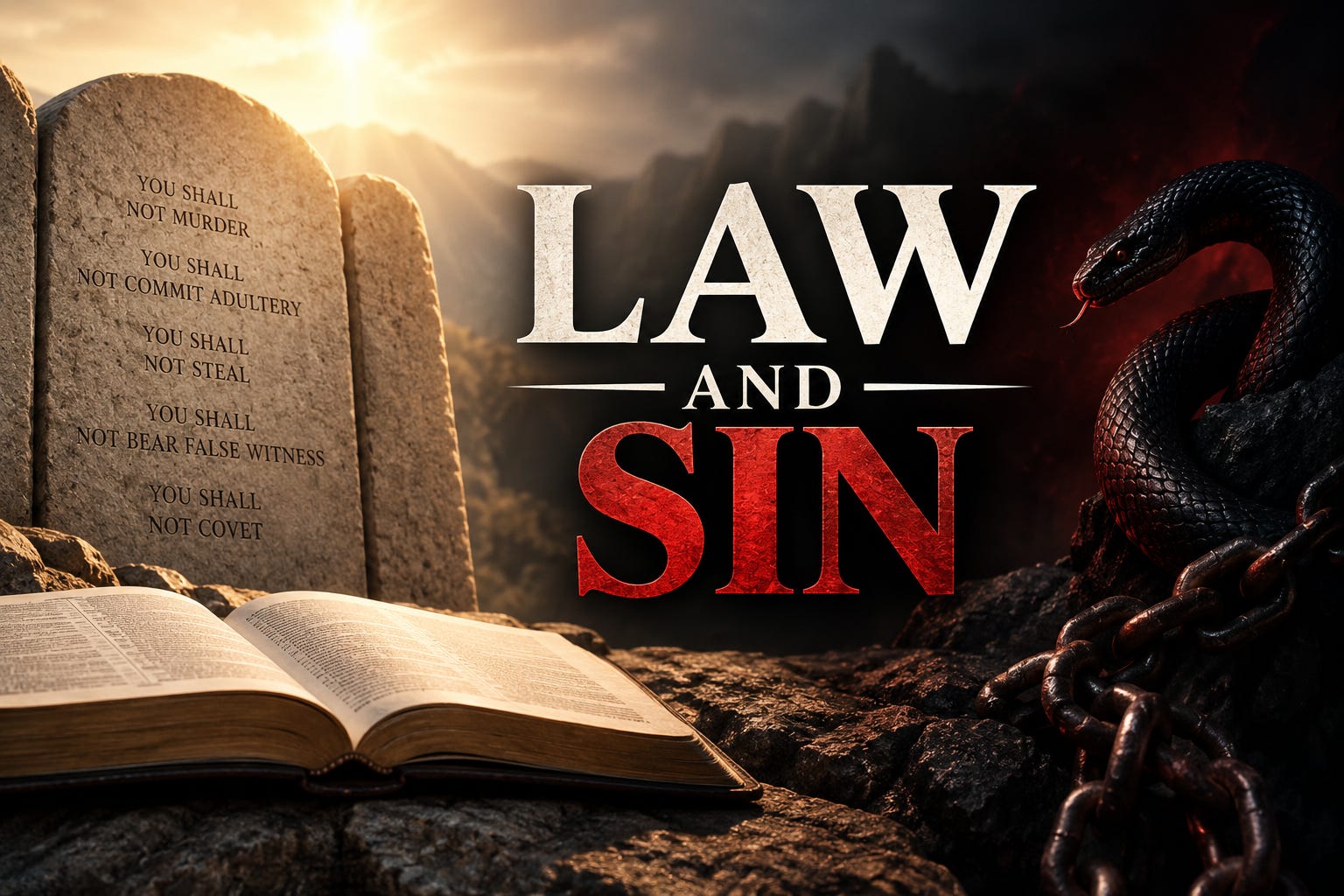
Sermon 24 of the series, “Romans: Gospel Blueprint.”
Paul answered another anticipated question: if believers are no longer under law but under grace, what is their relationship to the law? He answered using marriage as an illustration. Just as a wife is bound to her husband only while he lives, and is freed to remarry once he dies (7:1-3), so believers have died to the law through the body of Christ (7:4). This death was not our own doing; we died with Christ through union with Him (6:3-5), and its purpose was that we might belong to another, the risen Christ, and bear fruit for God (7:4). Paul then explained why release was necessary: while we were in the flesh, our sinful passions, aroused by the law, were at work in us, bearing fruit for death (7:5). But now, released from the law, having died to what held us captive, we serve in the new way of the Spirit, not the old way of the written code (7:6). That phrase: “sinful passions aroused by the law” raises a dangerous question Paul takes up next.
The Law is Not Sin
Paul anticipates another question. Is the law sin? His answer is NO. He explains the law’s value: to reveal sin. The apostle gives one example: covetousness. Without the law, man would not know what sin was.
Romans 7:7: What then shall we say? That the law is sin? By no means! Yet if it had not been for the law, I would not have known sin. For I would not have known what it is to covet if the law had not said, “You shall not covet.”
Paul shows that sin and the law are closely related, yet explains that the law does not lead us to sin.[1] Because sin is labeled as covetousness, sin is identified. But aside from that, what makes people sin is the sinfulness within them.
Sin, Not the Law
Paul unmasked the real problem. Not the law, but sin. But the sinful nature and its passions produced covetousness. The apostle explains that the law awakened sin, which led to death. He seems to be alluding to the serpent in Genesis.
Romans 7:8-11: But sin, seizing an opportunity through the commandment, produced in me all kinds of covetousness. For apart from the law, sin lies dead. 9 I was once alive apart from the law, but when the commandment came, sin came alive and I died. 10 The very commandment that promised life proved to be death to me. 11 For sin, seizing an opportunity through the commandment, deceived me and through it killed me.
He uses the pronoun “I,” which might even suggest that his statements are autobiographical, or that they are representative of every man under Adam.[2] Paul tells of a carefree life until he encountered the law. He refers to the promise of life to all who would keep that law (Lev. 18:5). But sin, the real culprit, interfered.[3]
The Law Did Not Bring Death
Paul clarifies again that the law is holy, good, and righteous. Did such a good thing bring death? His answer is again, NO. He repeats himself by stating that it was sin that produced death, and so that sin may be revealed. The commandment made sin clear.
Romans 7:12-13: So the law is holy, and the commandment is holy and righteous and good. 13 Did that which is good, then, bring death to me? By no means! It was sin, producing death in me through what is good, in order that sin might be shown to be sin, and through the commandment might become sinful beyond measure.
Paul uses the first person as autobiographical, but also representative of all under sin. He emphasizes the enormity of sin. Yet he did mention that grace is greater even though sin abounds (5:20).
Application
1. Do not treat the law as sin, but know that there is a close relationship between the law and sin. Instead, use the law to discover sins such as covetousness, adultery, gossip, deception, and pride.
2. Recognize that within every person is sin, and the knowledge of sin triggers it. Without the Holy Spirit giving us new life, sin produces death and is even triggered by the law, which is good.
3. Give thanks to the Lord for the new life in the Holy Spirit. Consider ourselves as dead to sin and dead to the law, and now joined to Christ. We identify with Christ’s death, burial, and resurrection (new life).
[1] James D. G. Dunn et al., Romans 1-8, Volume 38A (Zondervan Academic, 2018), 400.
[2] F. F. Bruce, Romans (IVP, 2015), 7:7-13.
[3] Colin G. Kruse, Paul’s Letter to the Romans (Eerdmans, 2012), 302.
Poem
LAW AND SIN
by Ed Pilapil Jr

Joined to Christ, into fellowship
With Him, we have relationship
But dead to the law and to sin
It is something so real within

Is the law sin, is it evil?
Not at all, it’s your bounded will
Through Adam, bound to sin, we are
It’s clear, sin wants to be the star

Through the law, sin arose within
It seized the chance, yes, that is sin
But the law is good and holy
Yet the fallen man wants folly

Paul’s style: autobiography
Representing humanity
Now his story is our story
In the end, it’s for God’s glory
Study Guide
1. Identify one purpose of the law. Explain (Ro 7:7).
2. How does sin operate with the law? Is there a possible parallel at the temptation in the garden? (Ro 7:8-11).
3. How does Paul describe the law? How does he describe sin? (Ro 7:12-13)
