


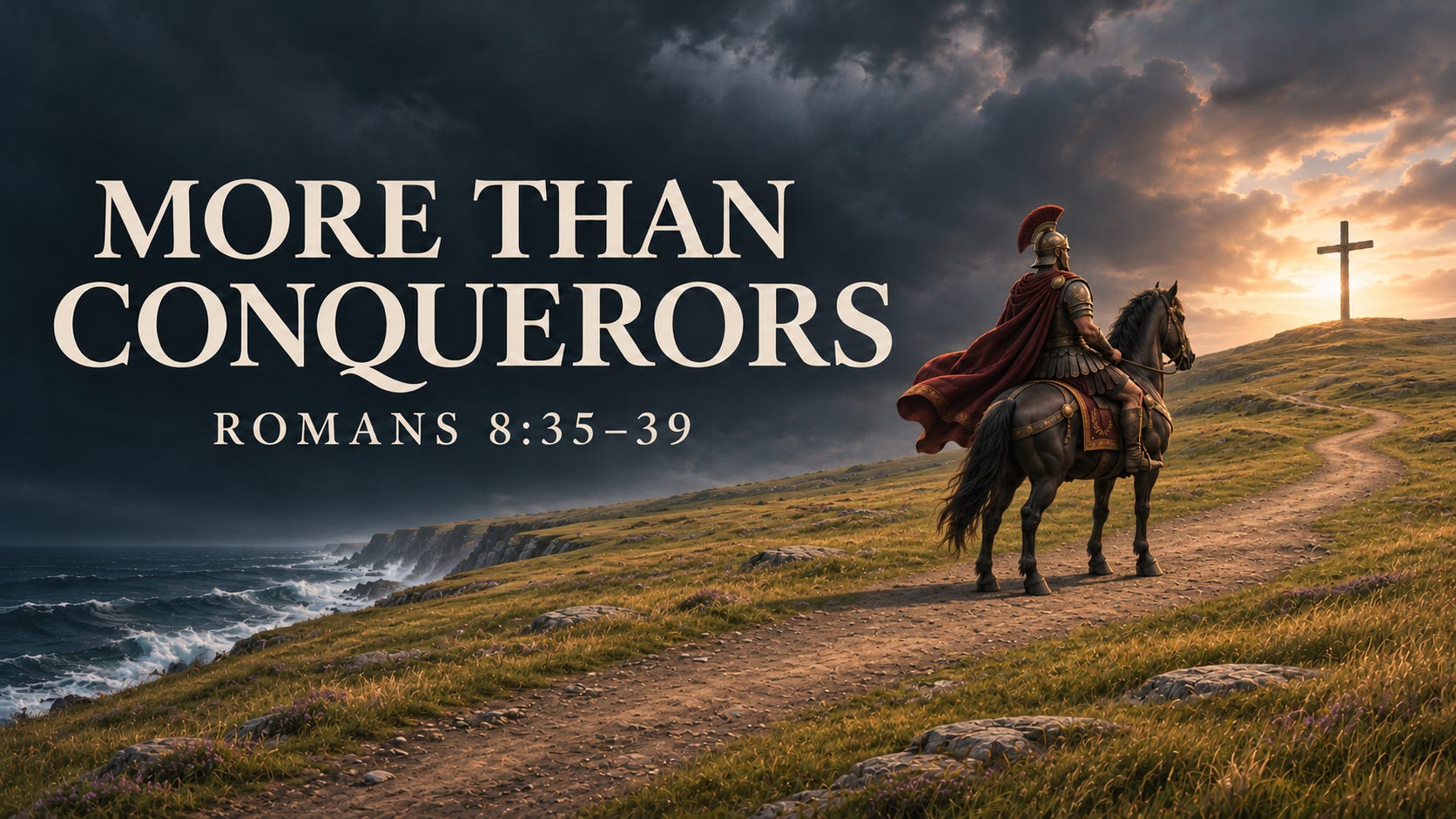
Sermon 32 of the Sermon Series “Romans: Gospel Blueprint.”
Review
Paul answered a question for every believer under pressure: when everything seems to come against us, can anything undo what God has done? He began with a question of his own: if God is for us, who can be against us (8:31)? The proof is the cross. God did not spare His own Son but gave Him up for us all, so how will He not also with Him graciously give us all things (8:32)? Paul then moved into the courtroom. Who shall bring any charge against God’s elect? No accusation will stand, because it is God who justifies (8:33). Who is to condemn? Christ Jesus died, was raised, is at the right hand of God, and is interceding for us (8:34).
That settles the verdict. But a suffering believer may still ask a more personal question: when trouble keeps coming, does Christ still love me? Paul answers by naming the worst that can happen. Then he ends the chapter on the highest note of assurance in the letter: nothing can separate us from the love of God in Christ Jesus our Lord.
Who Shall Separate?
Paul moves from the courtroom to the relationship. He leaves the language of charges and verdicts and speaks of the love of Christ.[1] The “who” in his question covers any opponent, whether a person or a circumstance. He then names seven hardships and quotes a psalm of lament.
Romans 8:35-36: Who shall separate us from the love of Christ? Shall tribulation, or distress, or persecution, or famine, or nakedness, or danger, or sword? 36As it is written, “For your sake we are being killed all the day long; we are regarded as sheep to be slaughtered.”
This is not theory. Paul had endured nearly everything on this list (2 Cor 11:26-27; 12:10), and the sword would come at the end of his life. “Separate” is a relational word. Some Jewish believers in Rome knew its meaning firsthand, having been expelled from the city under Claudius (Acts 18:2).[2] Hardship can separate us from home, health, and the people we love. Paul asks whether it can separate us from Christ.
Psalm 44:22 shows that the suffering of God’s people is nothing new. The psalmist cried out because God’s people had not abandoned His name, yet they were being humiliated and slaughtered. Paul quotes it to say that believers are not exempt.[3] Looking only at the hardship, one might wonder, like the psalmist, whether God has left His people. But what was a real question for the psalmist has become a rhetorical one for Paul, because Christ, the Lamb who was slain, has been raised.[4] Suffering is not evidence that God has left us.
More Than Conquerors
Paul answers his own question with one word: NO. He does more than deny that hardship can separate us. He says that we triumph in the very things that threaten us.
Romans 8:37: No, in all these things we are more than conquerors through him who loved us.
“More than conquerors” is one rare Greek word, and the English phrase goes back to the Geneva Bible.[5] It describes a sweeping victory, winning by a long distance. An ancient historian used the same word for a strongman who could outrun chariots.[6]
Notice the word “in.” “All these things” refers to the hardships Paul has just listed. He does not say that we conquer by escaping them, but in them. Under God’s hand, the very afflictions meant to pull us away become the means of our triumph (8:28). Just as Christ suffered and then triumphed, so will His people.[7]
And the credit does not go to our willpower. We conquer “through him who loved us.” Paul points to a love already shown. Christ’s love for us was demonstrated at the cross, and our victory flows from it. The believer may look defeated, like a sheep led to slaughter. But the One who was slain for us has already won.
Nothing in All Creation
Paul closes with a personal testimony: “I am sure.” This is not a mood but his settled, authoritative judgment.[8] He lists every threat he can think of, mostly in pairs, so that nothing is left outside the promise.
Romans 8:38-39: For I am sure that neither death nor life, nor angels nor rulers, nor things present nor things to come, nor powers, nor height nor depth, nor anything else in all creation, will be able to separate us from the love of God in Christ Jesus our Lord.
Death comes first, picking up the word “killed” in verse 36. Together, death and life cover the two possible states of our existence.[9] Angels and rulers take us into the spirit world. Evil powers would try to separate us but cannot, and good angels would never attempt it.[10] Things present and things to come cover all of time, including the hazards we have not yet faced. Height and depth speak of what would defeat any human being but poses no obstacle to God (Ps 139:8; Isa 7:11). If anyone in Rome feared the stars and fate, those fears are answered too.[11]
In case anything was left out, Paul adds “anything else in all creation.” God is sovereign over everything that exists, and everything that exists is created. That phrase most naturally includes even the believer himself.[12] We did not start this love, and we cannot end it.
Notice how the promise ends. The love of Christ (8:35) is the love of God in Christ Jesus our Lord (8:39). God’s love is known above all in the giving of His Son, and we experience it only in Him.[13]¹³ Paul closed chapters 5, 6, and 7 on that same name (5:21; 6:23; 7:25), and now chapter 8. The apostle has brought us to the peak of his argument. But if nothing can separate God’s people from His love, what about Israel? Paul turns to that question next.
Application
1. Let us not measure Christ’s love by our circumstances. Hardship is not proof that He has left us. When trouble comes, let us expect it, as Paul and the psalmist did, and let us bring our lament honestly to God.
2. Let us face our trials as those who conquer through Christ. We do not rely on our willpower or wait for the trial to end before we give thanks. In the middle of the difficulty, we look to the One who loved us and ask how He is using it for our good.
3. Let us name our fears and place them in Paul’s list. Whether it is death, the future, or our own failure, nothing in all creation can separate us from God’s love in Christ. Let us say with the apostle, “I am sure,” and let us stand beside believers who are suffering and remind them of the same.
Poem
MORE THAN CONQUERORS
by Ed Pilapil Jr

Who shall divide us from the love
Of Christ who reigns in heaven above?
Shall trouble, famine, danger, sword?
They cannot part us from our Lord

Like sheep for slaughter, all day long
The psalmist sang his grieving song
It's not a new thing that we face
Yet suffering can't outrun His grace

In all these things, we do not yield
For He who loved us is our shield
More than conquerors, we are strong
Through Him who's held us all along

Not death nor life, nor things to be
Nor height, nor depth, nor enemy
With Paul, I say that I am sure
In Christ, God's love will still endure
[1] Douglas J. Moo, The Letter to the Romans, 2nd ed. (Eerdmans, 2018), 565. Moo also notes that all the hardships except the sword appear in Paul’s own lists of sufferings.
[2] Frank S. Thielman, Romans, ed. Clinton E. Arnold, Exegetical Commentary on the New Testament (Zondervan Academic, 2018), 8:35.
[3] Thomas R. Schreiner, Romans (Baker Exegetical Commentary on the New Testament), 2nd ed. (Baker Academic, 2018), 455.
[4] Thielman, Romans, 8:36.
[5] Moo, The Letter to the Romans, 566.
[6] Thielman, Romans, 8:37; F. F. Bruce, Romans (IVP, 2015), 8:37, renders the word as super-conquerors.
[7] Schreiner, Romans (Baker Exegetical Commentary on the New Testament), 455-56.
[8] Schreiner, Romans (Baker Exegetical Commentary on the New Testament), 456.
[9] Moo, The Letter to the Romans, 566-67.
[10] Moo, The Letter to the Romans, 567. See also Bruce, 8:38
[11] Thielman, Romans, 8:38-39.
[12] Moo, The Letter to the Romans, 568.
[13] Moo, The Letter to the Romans, 568.
Study Guide
1. What does “separate” mean in this context? Why does Paul quote Psalm 44:22 right after his list of hardships, and what has changed between the psalmist’s question and Paul’s? (Ro 8:35-36)
2. What does it mean to be “more than conquerors” in these things rather than apart from them? Where does Paul place the credit for the victory? (Ro 8:37; cf. 8:28)
3. List the threats Paul names. What does the list as a whole teach about the reach of God’s love, and why does it matter that this love is “in Christ Jesus our Lord”? (Ro 8:38-39; cf. 5:21; 6:23; 7:25)
