


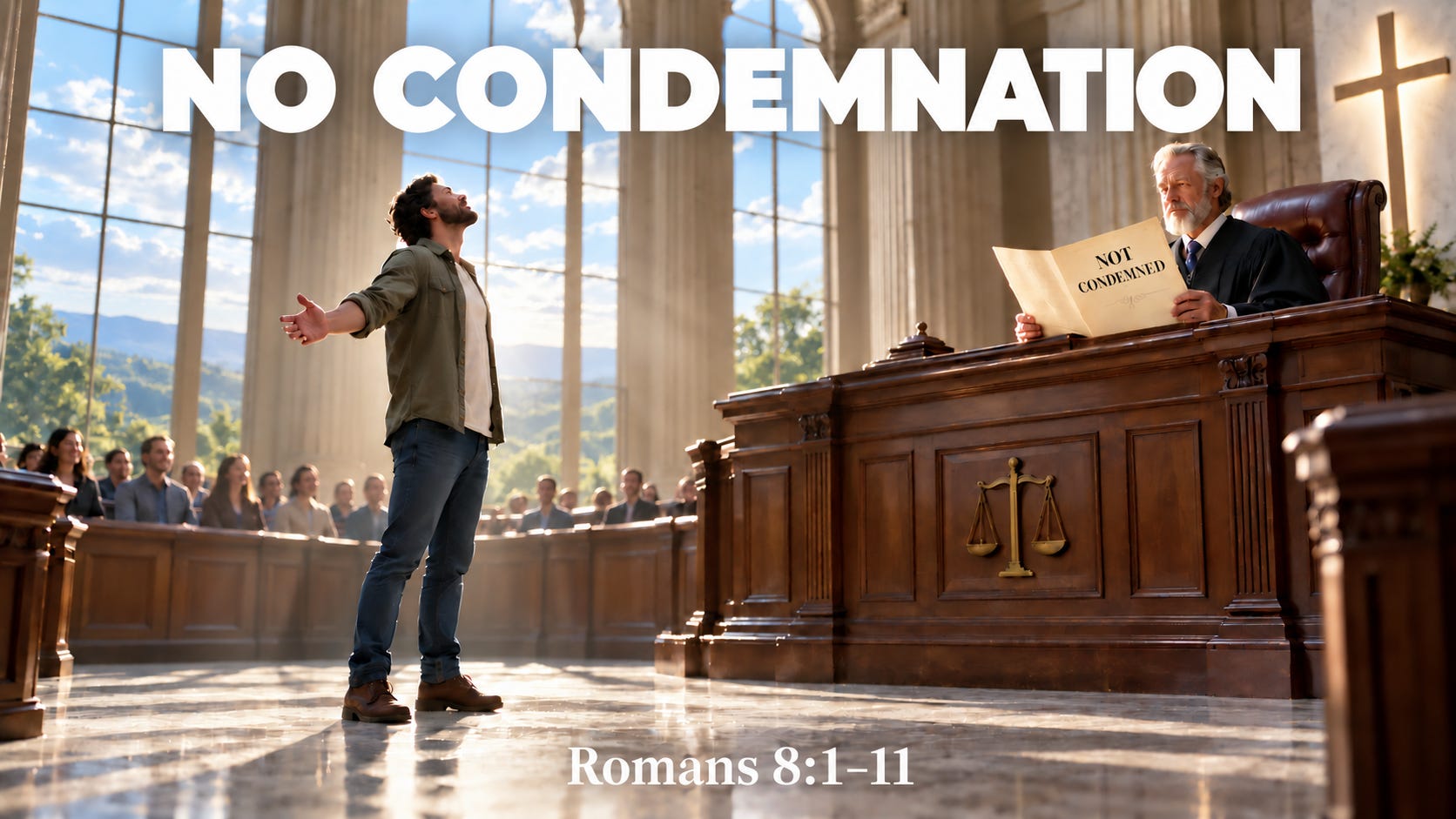
Sermon 26 of the series: “Romans: Gospel Blueprint.”
Paul explained why the struggle with sin continues even though the law is good. He stated the obvious: the law is spiritual, but he is of the flesh, sold under sin (7:14). He did not understand his own actions; he did not do what he wanted but did the very thing he hated (7:15). Yet his hatred of sin showed that he agreed with the law, that it is good, and he identified the real culprit as sin dwelling within him (7:16-17). The apostle then admitted that nothing good dwells in his flesh. He had the desire to do what is right, but not the ability to carry it out (7:18). Paul did not do what he wanted; he kept doing what he did not want (7:19-20). The apostle described it as a war within. He delighted in the law of God in his inner being, but another law in his members waged war against the law of his mind and made him captive to the law of sin (7:21-23). Frustrated, he cried out: “Wretched man that I am! Who will deliver me from this body of death?” (7:24). His answer came at once: “Thanks be to God through Jesus Christ our Lord!” (7:25). That cry of thanksgiving points to deliverance, but it leaves a pressing question for every struggling believer. If sin still wages war within us, where do we stand before God? Paul answers with one of Scripture's most comforting declarations.
No Condemnation
Paul opens with a verdict: there is no condemnation for those in Christ Jesus. The reason is not that believers stopped, but that God did what the law could not do. He sent His own Son to deal with sin, so that the righteousness of the law would be fulfilled in those who walk by the Spirit.
Romans 8:1-4, ESV: There is therefore now no condemnation for those who are in Christ Jesus. 2For the law of the Spirit of life has set you free in Christ Jesus from the law of sin and death. 3For God has done what the law, weakened by the flesh, could not do. By sending his own Son in the likeness of sinful flesh and for sin, he condemned sin in the flesh, 4in order that the righteous requirement of the law might be fulfilled in us, who walk not according to the flesh but according to the Spirit.
The law was not the problem; the flesh weakened it. So God sent His Son in the likeness of sinful flesh: truly human, yet without sin. The phrase “for sin” recalls the sin offering of the Old Testament.[1] Sin was condemned in Christ’s flesh, so it is no longer condemned in ours. Notice the order. The righteous requirement is fulfilled in us, not by us. It is the fruit of the Spirit, not the product of trying harder.
Two Mindsets
Paul contrasts two kinds of people: those who live according to the flesh and those who live according to the Spirit. Each has a mindset, and each mindset has an end. One leads to death; the other to life and peace.
Romans 8:5-8: For those who live according to the flesh set their minds on the things of the flesh, but those who live according to the Spirit set their minds on the things of the Spirit. 6For to set the mind on the flesh is death, but to set the mind on the Spirit is life and peace. 7For the mind that is set on the flesh is hostile to God, for it does not submit to God’s law; indeed, it cannot. 8Those who are in the flesh cannot please God.
Paul is not describing two stages of the Christian life but two categories of people: the unbeliever and the believer. The mindset on the flesh is not merely weak; it is hostile to God. It does not submit to His law, and it cannot. The flesh cannot please God, but the mind that’s set on the Spirit enjoys life and peace with God.
The Spirit Dwells Within
Paul turns directly to the believers: “you are not in the flesh but in the Spirit.” The proof is the indwelling Spirit. And the same Spirit who raised Jesus from the dead guarantees the future resurrection of the believer’s body.
Romans 8:9-11: You, however, are not in the flesh but in the Spirit, if in fact the Spirit of God dwells in you. Anyone who does not have the Spirit of Christ does not belong to him. 10But if Christ is in you, although the body is dead because of sin, the Spirit is life because of righteousness. 11If the Spirit of him who raised Jesus from the dead dwells in you, he who raised Christ Jesus from the dead will also give life to your mortal bodies through his Spirit who dwells in you.
Paul uses the “Spirit of God,” “Spirit of Christ,” and “Christ in you” interchangeably, a quiet witness to the Trinity. Every believer has the Spirit; one who does not have the Spirit does not belong to Christ. The body is still mortal because of sin, but the Spirit is life because of righteousness. The One who raised Jesus will also raise us.[2]
Application
1. Rest in His grace: no condemnation. We do not seek to sin, but when we do, remember that there is no condemnation for those joined to Christ in faith. Let us confess our sins from conviction but believe that there is no condemnation.
2. Examine our own minds. What we think about reveals the direction of our souls. Always set your mind on the things of the Spirit through the Word, prayer, worship, and fellowship with the church.
Live by the power of the indwelling Spirit, not our own willpower. The same Spirit that raised Jesus from the dead lives in us. Let us face temptation, weakness, and even death with hope that God will raise us with Him.
[1] James D. G. Dunn et al., Romans 1-8, Volume 38A (Zondervan Academic, 2018), 437-39. Dunn argues that “for sin” (peri hamartias) carries the technical sense of the sin offering.
[2] Frank S. Thielman, Romans, ed. Clinton E. Arnold, Exegetical Commentary on the New Testament (Zondervan Academic, 2018), 8:9-11.
Poem
NO CONDEMNATION
by Ed Pilapil Jr.

No condemnation, none at all
For those in Christ, both great and small
The Holy Spirit set us free
From sin and death’s captivity

What the law could never achieve
God did for all who would believe
He sent His Son in flesh like ours
Condemned our sin with holy power

The mind on flesh is death and war
It will stray and go very far
Set the mind, look to the Spirit
There’s life and peace, yes, believe it

In Christ, there’s no condemnation
Let this be your meditation
The Triune God works within you
For me and you, this has come true
Study Guide
1. Why is there “no condemnation” for those in Christ Jesus? What did God do that the law could not do? (Ro 8:1-4).
2. Contrast the mind set on the flesh with the mind set on the Spirit. What does each produce, and how does this connect to the struggle of Ro 7:14-25? (Ro 8:5-8).
3. What does the indwelling Spirit mean for the believer now and in the future? Draw your answer from the passage. (Ro 8:9-11)
