


Twenty-first in the Sermon Series. “Romans: Gospel Blueprint.”
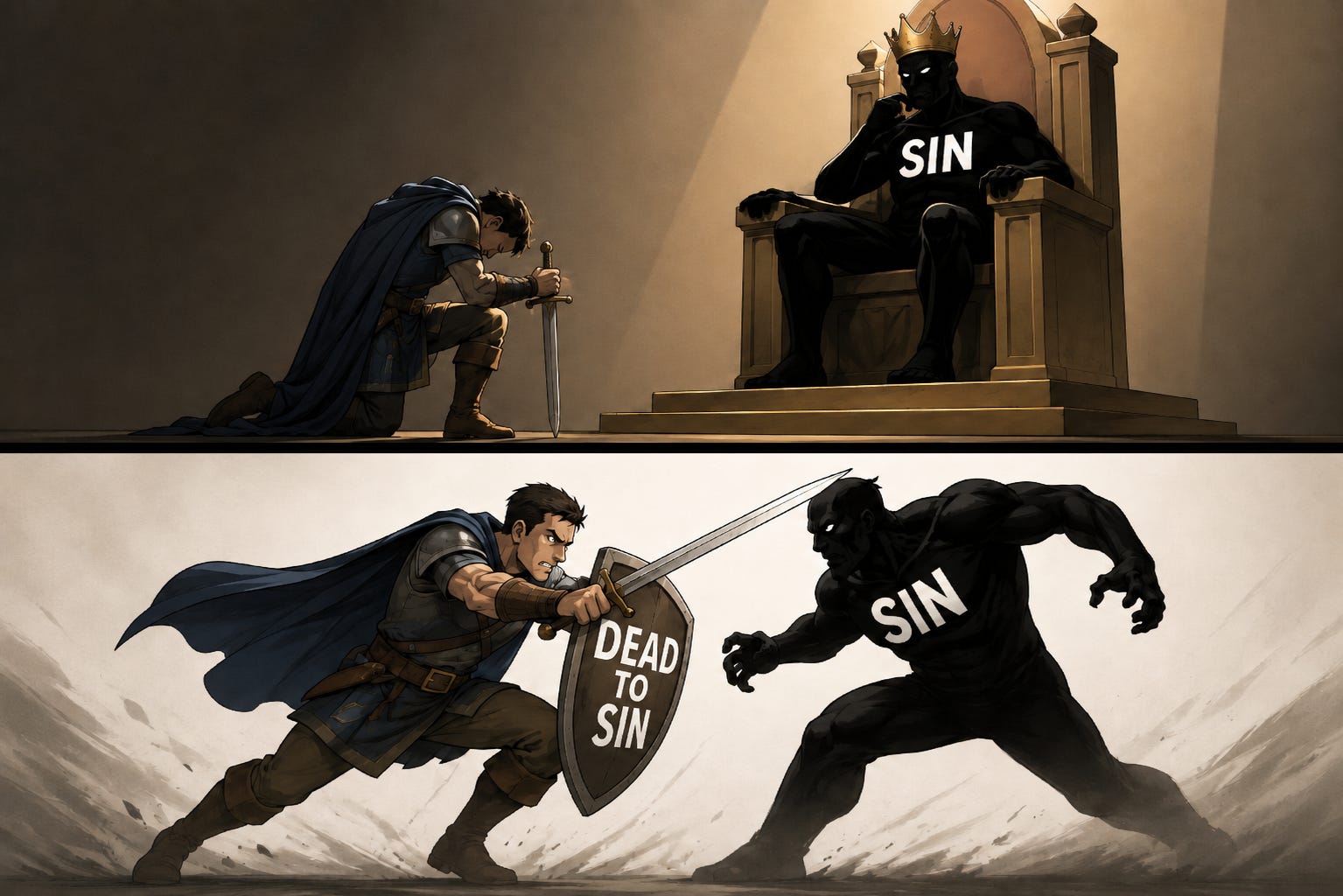
Paul taught that while sin, corruption, and condemnation entered humanity through Adam, far greater grace is available through Jesus Christ. However, the apostle clarifies that abundant grace is never a valid excuse to continue living in sin (6:1-2). The reason he gives is that a person who has genuine faith in Christ has died to sin. Paul illustrates this truth through the term “baptized,” which literally means “immersed.” A true believer is fully immersed into Christ’s death, burial, and resurrection. By being united with His death, the believer experiences a death to sin; by being united with His resurrection, they are raised to walk in a new life (6:3-4). Furthermore, Paul emphasizes that the old sinful self, inherited under Adam, was crucified together with Christ (6:5-7). Because of this crucifixion, sin no longer exercises dominion over believers. Therefore, those who have faith must consider themselves dead to sin and continually offer their lives to God as active instruments of righteousness.
No Dominion
Paul explains that those who died with Christ will also live with Him. He reminds them about the fact that Christ rose from the dead and He will never die again. Death has no dominion over Him because His death dealt with sin, but He now lives to God. His death was once in history and no longer repeatable.[1]
Romans 6:8-10: Now if we have died with Christ, we believe that we will also live with him. 9 We know that Christ, being raised from the dead, will never die again; death no longer has dominion over him. 10 For the death he died he died to sin, once for all, but the life he lives he lives to God.
People who genuinely have faith in Christ are united with Him in His death and resurrection. Sin has no more dominion over Christ because He had no sin. His death was because of the sins of those who would believe in Him. Christ will never die again. A genuine believer is joined to Him; thus, he will live for eternity.
Dead to Sin
Paul instructs believers to “consider” or “reckon” themselves dead to sin. Believers must believe it, count it as true that they are “dead to sin and alive to God in Christ.” Paul was leading them into a spiritual and mental state; this is not pretension, but a way of living.[2]
Romans 6:11: So you also must consider yourselves dead to sin and alive to God in Christ Jesus.
The apostle’s instruction is twofold. One is about being dead to sin, but the other is being alive to God in Christ Jesus. A life in Christ is not only about avoiding sin but also about being alive to God, which is the new life in Christ.
Do Not Let Sin Reign
Paul instructs the Roman believers not to let sin rule their bodies. Moreover, he tells them not to present themselves as “instruments of unrighteousness.” It means that although believers were freed from slavery, they must not revert to it. Conversely, believers must present themselves as “instruments of righteousness.”
Romans 6:12-14: Let not sin therefore reign in your mortal body, to make you obey its passions. 13 Do not present your members to sin as instruments for unrighteousness, but present yourselves to God as those who have been brought from death to life, and your members to God as instruments for righteousness. 14 For sin will have no dominion over you, since you are not under law but under grace.
Paul does not give a neutral ground. Either a person is an instrument of sin and unrighteousness or a person is an instrument of righteousness in Christ.[3] The reason why sin must not have dominion over the genuine believer is that they are not under the law but under grace. Remember that the law increases sin, but we are under grace. Thus, we are not to continue in sin (6:1-2).
Application
1. When you feel condemned or enslaved by a recurring sin, the first move is not to try harder; it is to remember whose you are. Let us believe with all our hearts, “I am united to a Christ over whom death and sin have no more dominion.”
2. When an old sin pattern presents itself as though it still has authority over you, consciously say (out loud if it helps), “I am dead to this; it no longer owns me, and I am alive to God in Christ.”
Let us take inventory this week of specific “members.” That includes our eyes, tongue, time, body, and relationships. Let us reflect on whether we have been presenting them to sin out of habit. Then make a deliberate, practical substitution: present that same member to God for righteousness instead.
[1] Frank S. Thielman, Romans, ed. Clinton E. Arnold, Exegetical Commentary on the New Testament (Zondervan Academic, 2018). Thielman states “Christ did not die to sin in the same way that believers die to sin. Unlike them he ‘knew no sin.’”
[2] Colin G. Kruse, Paul’s Letter to the Romans (Eerdmans, 2012), 267.
[3] Douglas J. Moo, The Letter to the Romans, 2nd ed. (Eerdmans, 2018), 409.
Poem
UNIFIED WITH CHRIST
byb Ed Pilapil Jr

All who died in Christ, they shall live
No payment, nothing we can give
A new life He gives; thus, believe
Grace is not something to achieve

Yet consider the self as dead
Heed what the Apostle Paul said
Dead to sin, alive to God, too
That’s a command for me and you

The mortal self, sin must not rule
Don’t look back; do not be a fool
No longer in unrighteousness
But instruments of righteousness

This is a new way of thinking
It is a new way of living
The old, old self was crucified
In Christ Jesus, we’re unified
Study Guide
1. How does knowing that “death no longer has dominion over” Christ change the way you face a temptation or sin pattern that feels like it has dominion over you? (Ro 6:8-10)
2. What two things, exactly, are believers told to reckon true of themselves, and why might Paul include both rather than just the first? (Ro 6:11)
3. What should a believer do and not do? Explain the mention of law and grace. (Ro 6:12-14)
