


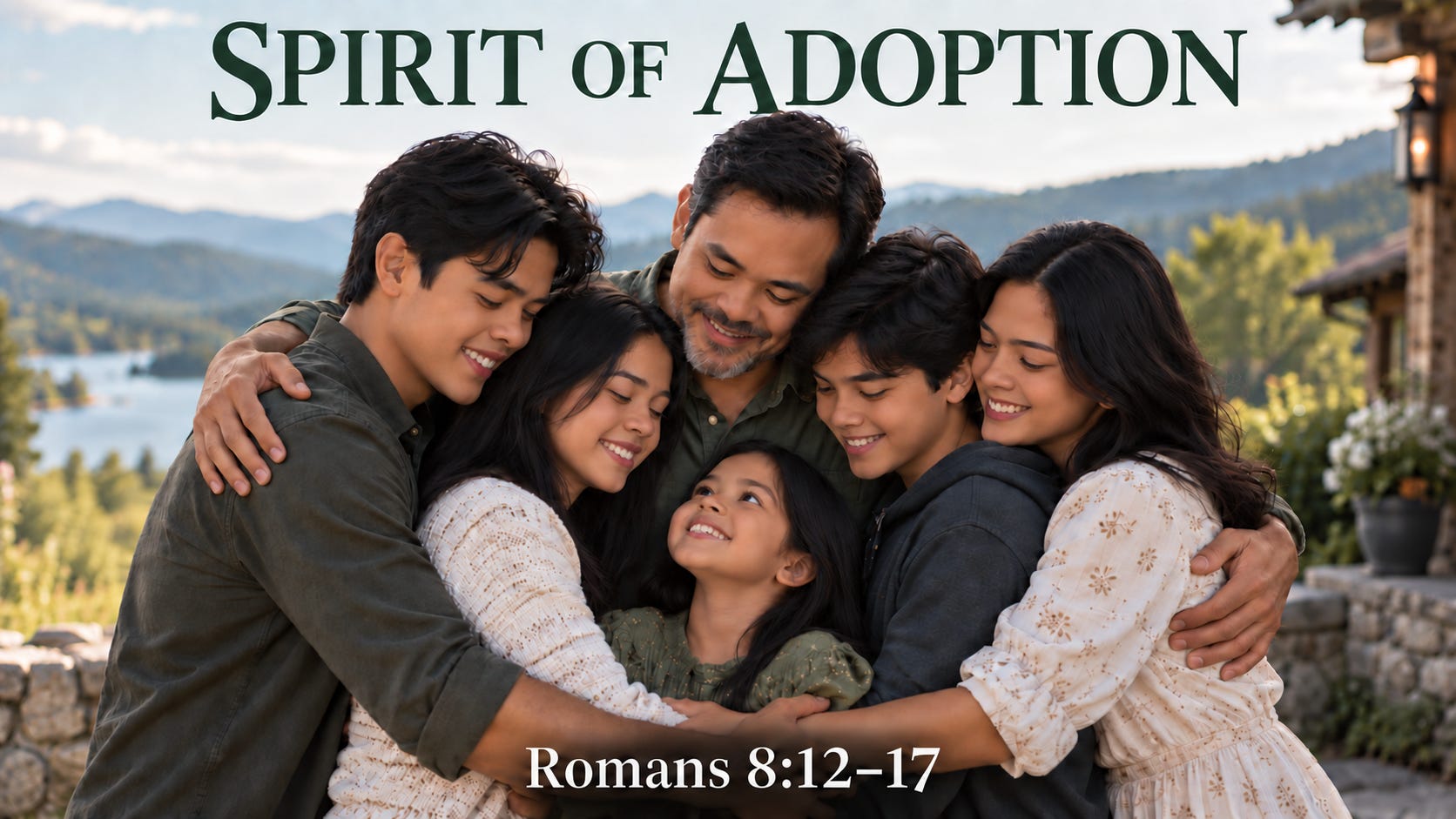
Sermon 27 of the series: “Romans: Gospel Blueprint.”
Paul answered a pressing question: if sin still wages war within us, where do we stand before God? He opened with a verdict: “There is therefore now no condemnation for those who are in Christ Jesus” (8:1). The law of the Spirit of life set believers free from the law of sin and death (8:2). God did what the law, weakened by the flesh, could not do. He sent His own Son in the likeness of sinful flesh and for sin, and He condemned sin in the flesh (8:3). The righteous requirement of the law is now fulfilled in us, not by us, as we walk according to the Spirit (8:4). Paul then contrasted two mindsets. Those who live according to the flesh set their minds on the things of the flesh; those who live according to the Spirit set their minds on the things of the Spirit (8:5). The mind that is set on the flesh is death; it is hostile to God and cannot please Him. The mind set on the Spirit is life and peace (8:6-8). The apostle then assured the believers that they are not in the flesh but in the Spirit, since the Spirit of God dwells in them (8:9). Though the body is mortal because of sin, the Spirit is life because of righteousness, and the One who raised Jesus from the dead will also give life to their mortal bodies (8:10-11). That settles the believer’s standing before God and the source of his power. But it raises a practical question: if the Spirit dwells within us, what do we now owe, and who are we now? Paul answers with an obligation and, more wonderfully, with adoption.
No Debt to the Flesh
Paul draws a conclusion from what he has just said. Since the Spirit dwells in believers and will give life to their mortal bodies, they owe the flesh nothing. The apostle then gives a warning: living by the flesh leads to death, but putting sin to death by the Spirit leads to life.
Romans 8:12-13: So then, brothers, we are debtors, not to the flesh, to live according to the flesh. 13For if you live according to the flesh you will die, but if by the Spirit you put to death the deeds of the body, you will live.
Paul uses the word “debtors.” Believers do have an obligation, but not to the flesh. The flesh was the old master, and its account has been closed. Yet like freed slaves who still hear the voice of their former master, believers can still be tempted to obey it.[1] The believer must put sin to death, but only “by the Spirit,” by yielding to the Spirit who already lives within.
Led by the Spirit
Paul explains why those who put sin to death by the Spirit will live. It is because they are led by the Spirit, and those who are led by the Spirit are sons of God. The apostle then contrasts two spirits: the spirit of slavery that brings fear, and the Spirit of adoption that brings us near to God as Father.
Romans 8:14-15: For all who are led by the Spirit of God are sons of God. 15For you did not receive the spirit of slavery to fall back into fear, but you have received the Spirit of adoption as sons, by whom we cry, “Abba! Father!”
In the Roman world, an adopted son received all the rights and privileges of a natural-born son.[2] That is our new status: not slaves trembling before a master, but sons welcomed by a Father. And so we cry, “Abba! Father!” Abba was the Aramaic word Jesus Himself used in prayer (Mk 14:36). The Spirit gives us the privilege of addressing God with the same word the Son used.
Fellow Heirs
Paul explains how believers know they are God’s children. The Holy Spirit Himself testifies with our spirit. And if we are children, then we are also heirs, heirs of God and fellow heirs with Christ. But the apostle adds a sobering condition: the path to glory passes through suffering with Him.
Romans 8:16-17: The Spirit himself bears witness with our spirit that we are children of God, 17and if children, then heirs—heirs of God and fellow heirs with Christ, provided we suffer with him in order that we may also be glorified with him.
The Spirit does not only make us God’s children; He also assures us that we are. His witness reaches the deepest part of our being, our own spirit, which is why the cry “Abba! Father!” is sincere and not forced. Then Paul moves from adoption to inheritance. We inherit only because we are joined to the Son, the true Heir of all of God’s promises. But union with Christ means sharing also in His suffering and then entering His glory.
Application
1. Refuse to pay a debt you no longer owe. When the flesh pressures you with its demands, remember that you are not its debtor. By the Spirit, put sinful habits to death by naming them, confessing them, and cutting off what feeds them, rather than tolerating them as harmless.
2. Approach God as a Father, not as a slave master. When you have failed, do not hide from Him in fear or try to earn your way back. Come to Him as His adopted child, and let your prayers begin, as Jesus’ did, with “Father.”
Rest in the Spirit’s witness that you are God’s child, not in your moods or circumstances. When suffering comes because you belong to Christ, do not conclude that God has abandoned you. Endure it as a fellow heir, knowing that the same path that led Christ to glory will lead you there too.
[1] Douglas J. Moo, The Letter to the Romans, 2nd ed. (Eerdmans, 2018), 518.
[2] Moo, The Letter to the Romans, 523.
SONS AND HEIRS
by Ed Pilapil Jr.

No longer debtors to the flesh
Its claims are gone, we start afresh
By the Spirit, put sin to death
To live in Him with every breath

All who are led, the Spirit’s own
Are sons of God, no more alone
Not slaves who fall again to fear
But children, adopted, brought near

We call out, “Abba! Father!” too
The word the Son once prayed, now true
The Spirit witnesses within
We’re God’s own children, freed from sin

If children, heirs with Christ the Lord
His glory is our sure reward
But first we share His suffering
Then glory with the Risen King
Study Guide
1. What does Paul mean when he says that believers are “debtors, not to the flesh”? According to the passage, who does the “putting to death,” and how? (Ro 8:12-13)
2. Contrast the “spirit of slavery” with the “Spirit of adoption.” What does each produce in the believer, and what does the cry “Abba! Father!” reveal about our relationship with God? (Ro 8:14-15)
3. How does the believer know that he is a child of God? What does it mean to be “heirs of God and fellow heirs with Christ,” and why does Paul connect this inheritance with suffering? (Ro 8:16-17)
