


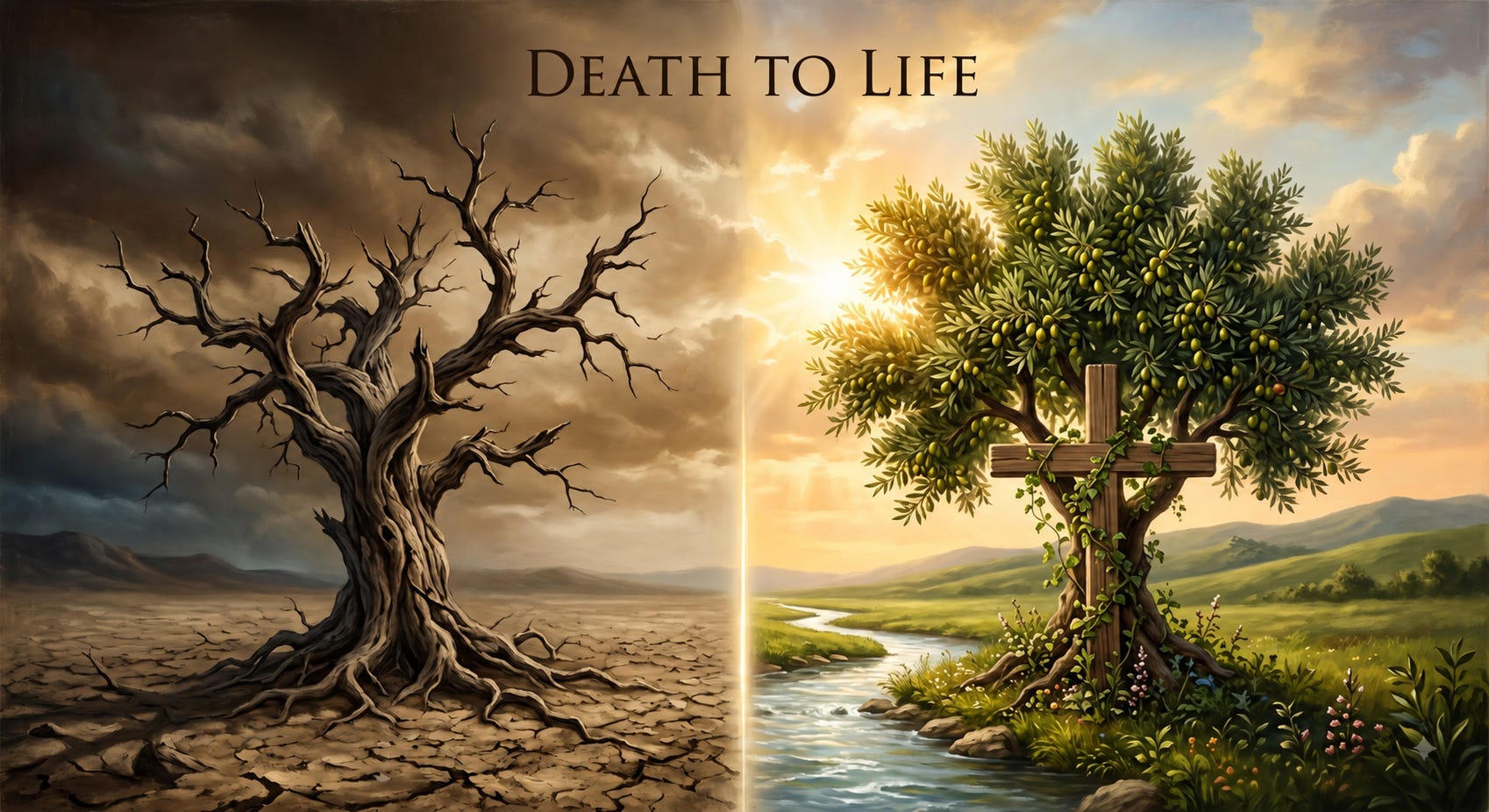
Nineteenth in the sermon series, “Romans: Gospel Blueprint.”
Paul assured that our hope is secure. Having been justified by faith, we have peace with God; we stand in grace and even rejoice in suffering, because suffering produces endurance, character, and hope; and this hope does not disappoint, for God’s love has been poured into our hearts by the Spirit. Paul’s clinching argument was that if Christ died for us while we were still enemies, how much more, now reconciled, will we be saved by his life. That is the settled ground of assurance. But Paul anticipates a fear. If our hope is so secure, what about the two great enemies that still stalk the human race, sin and death? Where did they come from, and can our hope really outlast them? The apostle would contrast two men, Adam and Christ. They are representatives, each one acting on behalf of a whole humanity. The question is simply: whose humanity are you in?
The First Man
Paul first traces how the two enemies got in. Through Adam’s single act, sin entered, and with sin came death, and death “spread to all.”[1] The proof is striking. Between Adam and Moses there was no written law to break, yet people still died. Paul had already said that “where there is no law there is no transgression” (4:15), so how could they die?
Romans 5:12-14: Therefore, just as sin came into the world through one man, and death through sin, and so death spread to all men because all sinned— 13 for sin indeed was in the world before the law was given, but sin is not counted where there is no law. 14 Yet death reigned from Adam to Moses, even over those whose sinning was not like the transgression of Adam, who was a type of the one who was to come.
His answer is that the reign of death over that lawless period is itself the evidence that sin was already present and reigning. Death is the fingerprint that betrays sin’s universal grip. We are not merely sinners because we imitate Adam; we stand under a condition inherited from him.
The Second Man
Paul contrasts Christ to Adam, but it is not a parallel. Christ did not just pay back what Adam lost; He gave so much more. Paul insists the work of Christ is not merely equal to Adam’s damage but exceeds it. Grace does not just balance the ledger; it goes past it.[2]
Romans 5:15-19: But the free gift is not like the trespass. For if many died through one man’s trespass, much more have the grace of God and the free gift by the grace of that one man Jesus Christ abounded for many. 16 And the free gift is not like the result of that one man’s sin. For the judgment following one trespass brought condemnation, but the free gift following many trespasses brought justification. 17 For if, because of one man’s trespass, death reigned through that one man, much more will those who receive the abundance of grace and the free gift of righteousness reign in life through the one man Jesus Christ.
18 Therefore, as one trespass led to condemnation for all men, so one act of righteousness leads to justification and life for all men. 19 For as by the one man’s disobedience the many were made sinners, so by the one man’s obedience the many will be made righteous.
Adam brought condemnation, but Christ brought justification. Adam brought sin and death, but Christ brought righteousness and life. Adam brought a sinful nature and a sinful environment upon men. But God, through Christ, sends the Holy Spirit (Ro 5:5, 8:9). Note that “life for all men” refers to all who are justified through faith, both Jews and Gentiles.
Grace Reigns
Finally, Paul folds in the law, the great event at Sinai that his account so far had seemed to skip. The common Jewish assumption was that the law was given to restrain sin. Paul’s claim is startling: the law came so that sin would increase, which may also mean that it would be exposed. Yet even that does not sink our hope, because he adds that where sin multiplied, grace multiplied all the more.[3]
Romans 5:20-21: Now the law came in to increase the trespass, but where sin increased, grace abounded all the more, 21 so that, as sin reigned in death, grace also might reign through righteousness leading to eternal life through Jesus Christ our Lord.
The passage ends in a throne room: sin once reigned in the realm of death, but now grace reigns through Jesus Christ our Lord. The last word of the chapter is not sin’s dominion but grace, righteousness, and eternal life.
Application
1. Everyone is a sinner because everyone sinned; yet all were born into original sin through the sin of Adam. Stop trying to argue that you are the exception. Admitting that we are sinners and helpless makes us appreciate the work of Christ.
2. The question is never “Have I done enough?” but “In whom do I stand?” When sin accuses you this week, do not answer with your effort; answer with your union to Christ, in whom grace abounds all the more.
3. The law was never the ladder to God; it is the mirror that drives us to grace. Let your growing awareness of sin push you not into despair but deeper into the reign of grace, under a King whose rule is toward life, not condemnation.
[1] Thomas R. Schreiner, Romans (Baker Exegetical Commentary on the New Testament), 2nd ed. (Baker Academic, 2018), 276-281. Schreiner cites Murray that all have sinned is unlikely because each person committed a personal sin, but rather, because all sinned in Adam. Schreiner states “Human beings enter the world condemned and spiritually dead because they sinned in Adam.
[2] Douglas J. Moo, The Letter to the Romans, 2nd ed. (Eerdmans, 2018), 362-68.
[3] Richard N. Longenecker, The Epistle to the Romans (Grand Rapids, MI: Eerdmans, 2016), 599.
Poem
THE GREATER ADAM
by Ed Pilapil Jr.

In Adam’s fall the whole world died
A shadow spread on every side
Through Adam, the reign of death came
Thus, each man sinned, each man to blame

When the corruption ran so deep
A second Man arose to reap
Paid the price and gave so much more
That’s righteousness, and more in store

The law came in, and sin increased
The debt in sin, it never ceased
But grace showed, greater than our shame
We have so much more in His name

No longer condemned, we’re not bound
We hear the call, we hear the sound
The sound we hear is Christ alone
The sound we hear is faith alone
Study Guide
1. People died before the law of Moses ever existed. What does that fact prove about sin? (Ro 5:12-14)
2. Why does Paul keep saying “how much more” instead of simply saying Christ undid Adam’s damage? (Ro 5:15-19)
3. If the law made sin increase, how is that good news? (Ro 5:20-21)
