


Sixteenth in the sermon series, “Romans: Gospel Blueprint.”
Paul focused his attention on Abraham. Abraham wasn’t declared righteous by his works. If he were, he could boast, but Scripture says his faith was credited to him as righteousness (4:3). David says the same: the truly blessed person is the one whose sins God does not count against him, apart from works (4:6-8). And crucially, this verdict came before Abraham was circumcised (4:9-12), so he is the father of all who believe, circumcised or not. Now Paul presses one step further: why did God arrange salvation this way? Because a promise received by faith rests on grace, and only grace can guarantee it for everyone. So he unfolds the promise, the people, and the power behind it.
The Promise Through Faith
God’s promise to Abraham was never attached to keeping the law. The law came 430 years later and could not add conditions to what grace had already given. In fact, law “brings wrath.” It names our failures and fixes their penalty. If the promise depended on obeying it, the promise would collapse, because none of us keeps it. Grace and law belong to different worlds.[1]
Romans 4:13-15, ESV: For the promise to Abraham and his offspring that he would be heir of the world did not come through the law but through the righteousness of faith. 14 For if it is the adherents of the law who are to be the heirs, faith is null and the promise is void. 15 For the law brings wrath, but where there is no law there is no transgression.
Once again, Paul highlights righteousness and faith. The law gives clarity of judgment to all who failed to keep all that is in it (Dt 27:26). There is no righteousness in the law. There is only righteousness through Christ by faith.
The Promise Rests on His Grace
The reason why it is by faith is that righteousness depends on His grace. Because it rests on grace, the promise is secured. Abraham is “the father of a multitude of nations,” not merely of his natural children, but of all who follow the pattern of his faith, Jew and Gentile alike.[2]
Romans 4:16-17: That is why it depends on faith, in order that the promise may rest on grace and be guaranteed to all his offspring—not only to the adherent of the law but also to the one who shares the faith of Abraham, who is the father of us all, 17 as it is written, “I have made you the father of many nations”—in the presence of the God in whom he believed, who gives life to the dead and calls into existence the things that do not exist.
Grace makes the family door wide, and grace makes the inheritance certain. If righteousness rests on human performance in keeping the law, then it is uncertain. But because it is through His grace, it becomes certain.
Faith, Fully Convinced
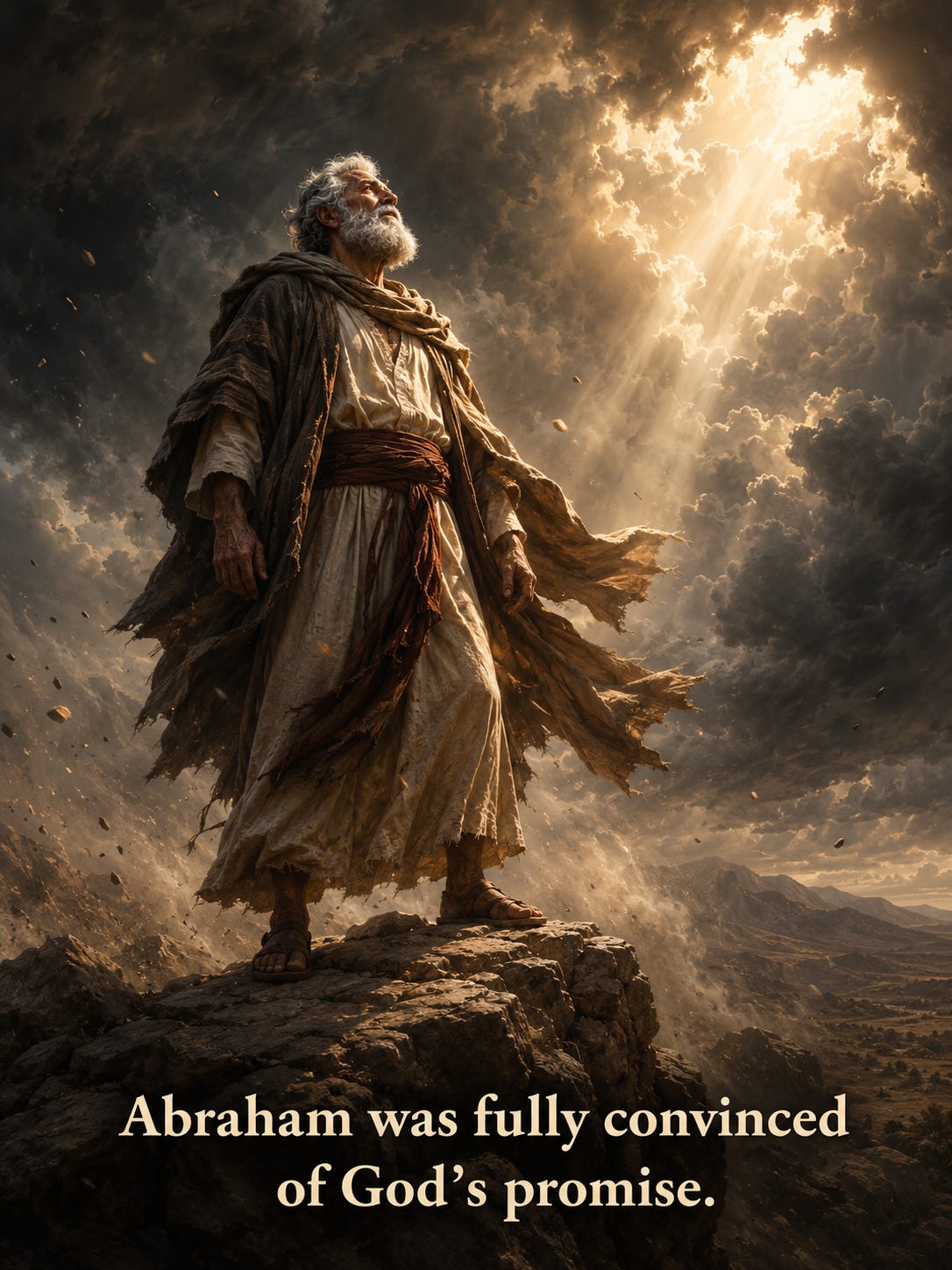
Consider the confidence of Abraham’s faith. He was old, Sarah was barren, and every circumstance said: “impossible.” He didn’t ignore the facts; he weighed them against God’s promise and found God heavier. Abraham was fully convinced that God would keep His promise despite the impossibilities.[3]
Romans 4:18-25: In hope he believed against hope, that he should become the father of many nations, as he had been told, “So shall your offspring be.” 19 He did not weaken in faith when he considered his own body, which was as good as dead (since he was about a hundred years old), or when he considered the barrenness of Sarah’s womb. 20 No unbelief made him waver concerning the promise of God, but he grew strong in his faith as he gave glory to God, 21 fully convinced that God was able to do what he had promised. 22 That is why his faith was “counted to him as righteousness.” 23 But the words “it was counted to him” were not written for his sake alone, 24 but for ours also. It will be counted to us who believe in him who raised from the dead Jesus our Lord, 25 who was delivered up for our trespasses and raised for our justification.
He trusted the God “who brings the dead to life.” And Paul says this was written for us, who believe in the God who raised Jesus, delivered up for our sins and raised for our justification.
Application
1. Stop trying to earn what God gives freely. When you make your standing with God depend on your performance, you don’t strengthen the promise; you disrespect it. Rest instead on grace, which is the only ground that can actually hold you.
2. Your place in God’s family doesn’t depend on background, heritage, or track record. If you share Abraham’s faith, you share Abraham’s blessing. And since it rests on God’s grace, not your grip, your inheritance is as certain as God himself.
3. Faith isn’t pretending the obstacles aren’t real; it’s setting them beside God’s word and trusting his power to be greater. The same God who gave life to Abraham’s dead hopes raised Jesus — and that is the God who justifies you today.
[1] F. F. Bruce, Romans (IVP, 2015), 4:13-15.
[2] Douglas J. Moo, The Letter to the Romans, 2nd ed. (Eerdmans, 2018), 4:16-17.
[3] Thomas R. Schreiner, Romans (Baker Exegetical Commentary on the New Testament), 2nd ed. (Baker Academic, 2018), 4:18-21. Schreiner stresses that Abraham’s faith was “God-centered” and must “not be confused with breezy optimism, nor does it involve a denial of external reality”; Abraham “carefully ‘considered’ the obstacles.” What sustained him “was a vision of the God who could do the impossible.”
Poem
THE PROMISE
Ed Pilapil Jr

The promise rests on the LORD’s grace
Oh, how marvelous are His ways
If by the law, and not by grace
Then Jew and Gentile have no place

We’re Abraham’s children through faith
A grandfather who is great, great
Not by blood, but in Christ, through faith
God used him to show us the way

Fully convinced of the promise
Despite impossibilities
Abraham believed the promise
Not in his own capacities

His faith was recorded for us
The word, is for us to discuss
Faith that’s all in, that should be us
Locked in, our faith in Christ Jesus
Study Guide
1. The promise to Abraham: why not through the law and why through faith? (Ro 4:13-15)
2. Why should the promise of righteousness depend on faith? (Ro 4:16-17)
3. Explain the quality of Abraham’s faith as Paul explained. (Ro 4:18-25)
